Where it went was her local dispensary. “I was so overwhelmed by all the options. I knew my [hospice] patients could benefit from this, but if I couldn’t even navigate all the options at 30 years old, how could they at 65? Patients need guidance.”
Megan went on to get her Master of Science in Medical Cannabis Therapeutics from the Pacific College of Health Sciences and founded
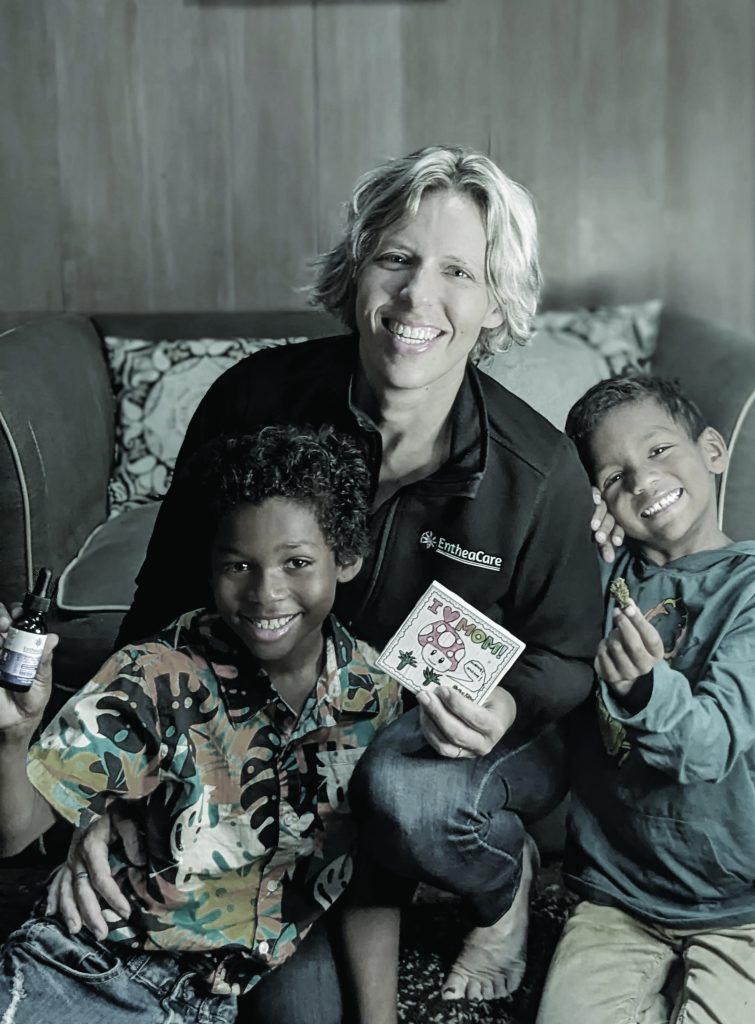
EntheaCare, a hemp-product company that aims to bridge the gap between patients and cannabinoid medicine. All while raising her two boys, ages 7 and 10.
Learning to Listen to Your Body
When I asked Megan how cannabis changed her as a parent, she answered quickly. “The plant softened my edges. I became more present and less strict with my boys.”
It was a process of dropping in and getting to know herself better.
“Cannabis opened up a world of being able to connect with my body, for the first time in my life. I could listen to what my body was saying, in terms of food, pain, body image – all of that.”
Changing her relationship with herself and her body also changed her relationship with motherhood.
“I teach my kids how to listen to their bodies and respond. I share tools with them, like meditation and body scans. These were things I had never done before cannabis. But now, I can teach them how to listen to their intuition.”
Like many people, cannabis led Megan down a path of diving deeper into herself and her body.
“I learned other ways to maintain my endocannabinoid system, working out, meditation, sound baths, and breath work.”
The magic of cannabis often happens in the introspection, the quiet moments after consumption, when whispers become clear. There’s something about the plant that often makes it easier to listen to one’s inner knowing.
“One of the most profound changes that I remember from then [when cannabis became a part of her life] is around my workouts,” Megan said. “I was working out six days a week, this highly regimented workout, no matter what else was going on. When I started consuming cannabis and listening to my body, I realized that I don’t have to do it if it doesn’t feel good.”
Six years later, that mindset still guides her. “If I’m feeling it, I’m going to do what works best for me. And if I’m not feeling it, I don’t have to do it.”
Cannabis and Kids: A Nurse’s Perspective
Working in the industry from a medical perspective makes Megan uniquely equipped to lead a conversation about cannabis with kids. Not just her own; Megan wrote an article for the
Kids & Cannabis edition on
how to talk to your kids about weed, broken down by age.
And her strategy is no different when it comes to her boys. “We talk about it. I approach it like any other medicine. In my house, CBD is like Windex from My Big Fat Greek Wedding.’
Her education on the plant also gives her a broader range of how cannabis can help, especially outside of THC. “CBD goes on rashes and wounds. My kids take it for headaches. We use CBG for anxiety. It’s all very normal in my house.”
Her training and knowledge of the plant make her comfortable dosing all the cannabinoids for her kids, when appropriate. “I have given my kids THC [in dry herb vapes] when they’re so ill they can’t keep food down. It’s not a common thing, but it can help.”
It helps to understand each cannabinoid so deeply that the right situation is obvious. Her older son plays soccer and is at high risk for concussions. Megan has written before about
cannabis protocols for concussions, both for adults and kids, and her son has needed it before.
When it comes to her kids’ perspective on cannabis, Megan wants them to be discerning above all else. “My hope is that my kids grow up to be weed snobs. They can be knowledgeable for their classmate. If someone brings a D8 vape, they know it’s trash. They’re not even interested in consuming that manufactured garbage.”