
This article was first published in the Cancer edition of Fat Nugs Magazine in July 2026.
Cancer is not one disease. Cannabis is not one molecule
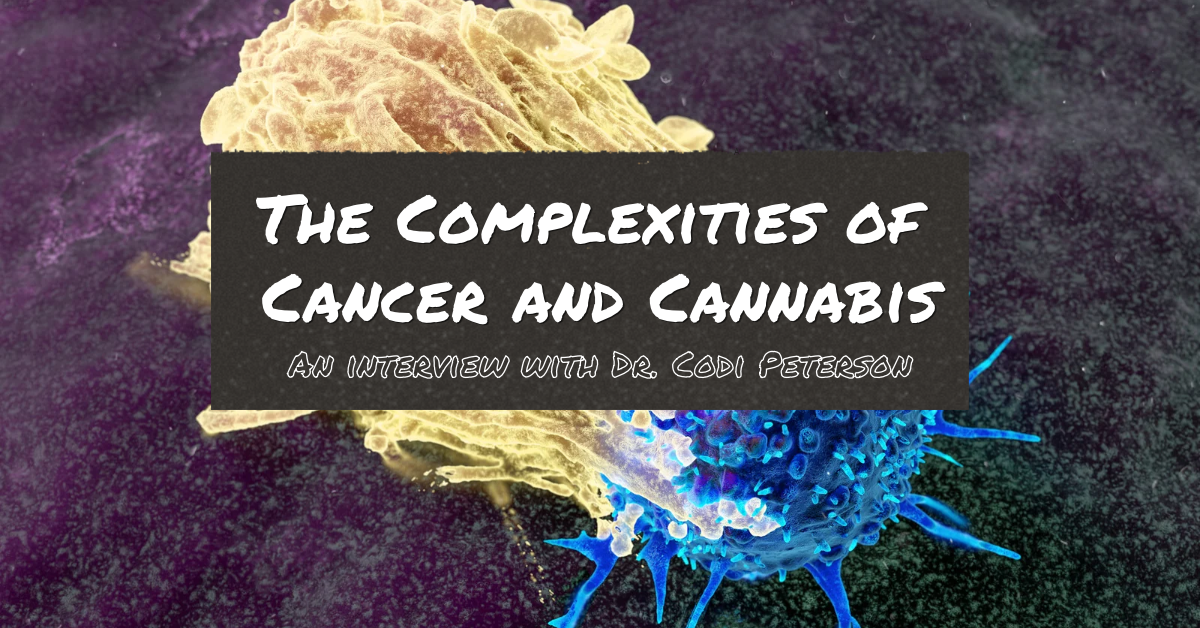
Codi Peterson has an impressive resume that qualifies him to wade into the complex conversation around cancer and cannabis.
He is a clinical pediatric pharmacist in an emergency department, the co-founder of the Pharmacists’ Cannabis Coalition of California, and an educator, teaching at UC Irvine, hosting classes for paramedics, and sharing resources on social media. If that weren’t enough, Codi is also a board member at Americans for Safe Access and the former Chief Science Officer at The Cannigma, a digital cannabis educational resource.
My conversations with Codi have long gotten into the meaty, complex scientific nuances around cannabis. Several years ago, I interviewed him about cannabis and pregnancy— talk about necessary nuance. When I want to understand the facts, the provable aspects of a cannabis question (not the social media hype), he’s one of the first people I turn to.
Codi’s story with cannabis is deeply intertwined with cancer. He was a burgeoning young pothead making brownies in college when his girlfriend’s grandmother was diagnosed with stage four pancreatic cancer.
“They had her on the traditional medical regimen [for end-of-life care],” Codi told me. “She was zonked. But she asked for cake, and I made her cake. She had a slice and had the best day she’d had in a long time. She ate a second slice the next day and passed away peacefully.”
That experience shaped Codi’s beliefs around what cannabis can do for people with cancer.
“Cannabis didn’t fix things. What it did was give her dignity and peace, improve her mood, and give her an appetite. It’s a question about quality of life.”
Understanding Cancer as Multiple Diseases
Despite its umbrella term, cancer is much more complex than a single disease. The Cancer Research Institute recognizes over 200 diseases “characterized by uncontrolled cell division, each with unique traits.”
The most common misconception around cannabis and cancer, Codi emphasizes, is that this is a simple conversation.
“The most important framework here is to consider what we’re dealing with. You’ve got cancer— what kind? There are hundreds of types of cancer, each with potentially dozens of subtypes. What are you trying to do with the cannabis? Which cannabinoids are we talking about? How are you dosing it?”
Oftentimes, excitement can take over the conversation, barreling over important nuance and scientific findings. While research on cancer and cannabis has been stilted by prohibition, what exists is already proving complex.
“Most studies show that THC doesn’t do much for curing cancer,” Codi said. “If it did, people who smoked weed likely wouldn’t get cancer, and that’s not the case.”
What Anti-Cancer Properties Mean for Cannabinoids
One of the biggest topics I want to dig into is the term “anti-cancer”— a property often referenced in studies around cannabinoids and cancer. But what does “anti-cancer” actually mean?
“The best way to think about it is, when we give THC to cells or tissues, whether human or animal, we see changes in those cells or in those tumors, interacting with the cellular pathway to cause apoptosis—cell death,” Codi said. “THC has been shown to activate already existing pathways that end the life cycle of that cell. The endocannabinoid system is highly interwoven with that same pathway.”
Since cancer is caused by our own cells growing and duplicating too quickly, turning them “off” can be beneficial. But it’s not as straightforward as “THC kills cancer cells.”
“We’ve seen numerous animal models and test tube studies that have really great results,” Codi said. “But we don’t have a lot of human data, which is concerning.”
The research that does exist is often conducted in test tubes and sterile labs, not complex human bodies. This is a traditional scientific research progression, but it also complicates directly applying the findings to potential real-world benefits.
As Codi puts it, “We are complex living things, and what cannabinoids have done in human studies has not been nearly as robust or reassuring as it is in the test tubes.”
Additionally, the dosage of THC used in these studies is often much higher than what typical consumption can deliver, which raises questions around exactly how much weed a person would have to consume to see similar results.
This conversation is complicated because cannabis, cancer, and human bodies are complicated. It’s a question that intersects the type of cancer a person has, how progressed it is, what the chemical makeup of cannabis products is, and the general predisposition of a given person to cannabis. It’s not nearly as simple as visiting a dispensary and lighting up a joint.
The Personalization of Cannabis for Cancer
Injecting nuance into this conversation is hardly exciting. But in a time when the abilities of cannabis are being both overpromised and vilified, it’s vital to ground down into fact.
One of the biggest factors to success within the cancer and cannabis conversation is understanding what, exactly, cannabis can do for a person.
“There are two different use cases.” Codi elaborated. “Are you looking for a cure? Or, are you looking to manage symptoms of treatment and improve your quality of life?”
This question is key to setting patients up for success in consuming cannabis.
“Every cancer fight is different. What kind of cancer are we talking about? Is it stage one or stage four?” Codi said. “Where someone is at in the disease course, the goals of their therapy, the type of cancer they have— all of those specifics will drive the right cannabinoid choice.”
A high dose of RSO via a suppository may work well for one person, while another prefers to take tokes off a one-hitter packed with hemp flower. It’s not a one-size-fits-all solution— which is what makes it both so complicated and so promising.
Minor Cannabinoids for Cancer Treatment
What about CBD, the headline-grabbing cannabinoid that’s being included in everything from tinctures to pillowcases?
“There’s a lot of literature around CBD,” Codi said. “But there is reason to bring calmness to this conversation, because CBD is really hard to study in test tubes. The benefit is going to be cancer-specific.”
What would really move the needle and push the conversation forward is more research. But not just any research —studies that move outside of the sterile lab environment.
“We need more large-scale, long-term multi-cannabinoid, multi-cancer studies. Real-world, human data and peer-reviewed research. Test tube studies can only bring us so far.”
None of this, Codi emphasizes, is reason to write off the possibilities of mitigating cancer’s effects with cannabis. People can and do benefit from this plant while fighting cancer every day.
“Cannabinoids are generally non-toxic and well-tolerated in people. I’m not here to tell people what to do. I want patients to know their tools and their options.”
As a medical professional deeply invested in cannabis and the endocannabinoid system, what would Codi tell a patient with cancer? Again, it’s a nuanced question.
“It totally depends on what their goal is. Do they want to use it to fight the cancer? Do they want to improve their quality of life during other treatments? Or, are they looking to enjoy what time they have left?”
Answers to these questions drive product recommendations, dosing, and consumption.
RSO for Cancer
I can’t let this conversation go without bringing up the hottest topic in the cannabis/cancer conversation: RSO.
Rick Simpson Oil is a potent, highly concentrated form of cannabis that was popularized by Rick Simpson, who said he used it to cure his cancer. It’s controversial, and its efficacy is hotly debated between the cannabis and medical spaces.
For better or worse, RSO is not going anywhere in the cancer conversation. But given the promising results of test tube studies with high doses, could the potency of RSO facilitate efficacy?
“Possibly,” Codi said. “It’s a full plant extract, not an isolate. It’s a complex matrix of interactions. It’s possible that certain cancers respond well to THC. It’s reasonable to think whole plant medicine could work better than an isolate gummy.”
What’s in the RSO matters too. “Traditionally, it’s a high THC concentrate. But RSO made from a type II flower would have a completely different makeup.”
The type of cancer also plays an important role. “[Rick] used it for topical purposes,” Codi said. “He applied it directly to the area with cancer. The risks and potential harms of topical applications are much lower.”
RSO is one of those suggestions that elicits strong reactions from both sides of the belief system. People who believe in it, really believe. However effective it is or isn’t, RSO isn’t a miracle cure.
“People get sold hope in the form of RSO, but there’s a lot of work to be done to tease apart the issue of how, if, and why it works. We need more research, now.”
Endocannabinoid Stimulation for Cancer, Without THC
Endocannabinoid stimulation has a lot to do with the potential benefits of cannabis. I asked Codi if there are other ways people can stimulate their ECS to potentially create similar benefits.
“Our diet affects our ECS in ways we don’t fully understand. Changing your diet could have an impact that’s really hopeful for fighting cannabis.” Codi said.
In fact, there’s a long list of things that can stimulate your ECS, many of them based in Eastern healing traditions.
ECS-stimulating activities include:
- Gentle exercises
- Morning and evening sun
- Good sleep: regularly getting 8 hours
- Mind/body connections: mindfulness and meditation
- Yoga
- Socializing with loved ones
How to Move the Conversation on Cancer and Cannabis Forward
The fact that this is not a simple conversation may be a hard pill for the vehemently pro-cannabis crowd to swallow, but like all biologically active substances, there’s nuance here.
The conversation around cancer and cannabis needs to start with a few simple questions:
- What kind of cannabis do you have?
- What stage?
- What is your goal with cannabis?
- What cannabinoids are you consuming?
From there, the conversation needs guidance from a person who understands cannabis, cancer, and pharmacokinetics, to avoid potentially deadly drug interactions. Unfortunately, people with that level of knowledge are hard to come by.
While there are very real potential benefits to consuming cannabis for people with cancer, there is still so much we don’t understand.
“I understand why people are searching for hope,” Codi said. “Cannabis can provide tremendous value in fighting cancer. But we don’t have the evidence to mass direct people to a “cure” when it’s not.”
At the same time, the placebo effect works. And when people are facing life-threatening diseases, belief in the efficacy of their treatment goes a long way toward success. The reputation of cannabis for cancer has been built up for decades, and with good reason. The cannabis community knows that the research is behind on the potential benefits of this plant, and the conversation around cancer is no different.
Ultimately, there’s only so much stoners can do on our own. We need more clinical trials, more research on cannabinoids outside of THC, and medical professionals to have a better understanding of the endocannabinoid system.
“People with cancer are searching for hope,” Codi said. “It’s critical to push this forward to get better data so patients aren’t left looking to one-off stories and getting shut down by doctors.”
Subscribe to Fat Nugs Magazine!
Love this article? Show your support for Fat Nugs with a magazine subscription!
As a fully independent media organization, Fat Nugs relies on the grassroots support of individuals like you to continue to write and share these articles. Every subscription helps us keep bringing you the unbiased, broad-ranging cannabis, hemp, and psychedelics articles like these.