
This article was first published in the Landrace edition of Fat Nugs Magazine, shared in April 2026.
Fact: There has never been a better time to be a stoner.
10,000 years ago, your strain selection looked like something like this: whatever random weed happened to grow outside your cave. No menu. No choices. No service. Just wild cannabis shaped by dirt, environment, and dumb luck.
You ventured outside, spear in hand, fear in heart, and harvested, hoping you wouldn’t be eaten alive by a giant short-faced bear. You were Fred Flintstoner looking to get high, but the world was a dangerous yabba-dabba zoo of animals that could and would kill you.
Still, you risked it all so you could puff puff pass and share a laugh with the homies around the fire and see who could make the dopest art on the cave wall.
Cannabis Today
We worry about finding parking and high taxes at a pristine store with a menu that reads like a craft beer festival made a love child with a candy factory.
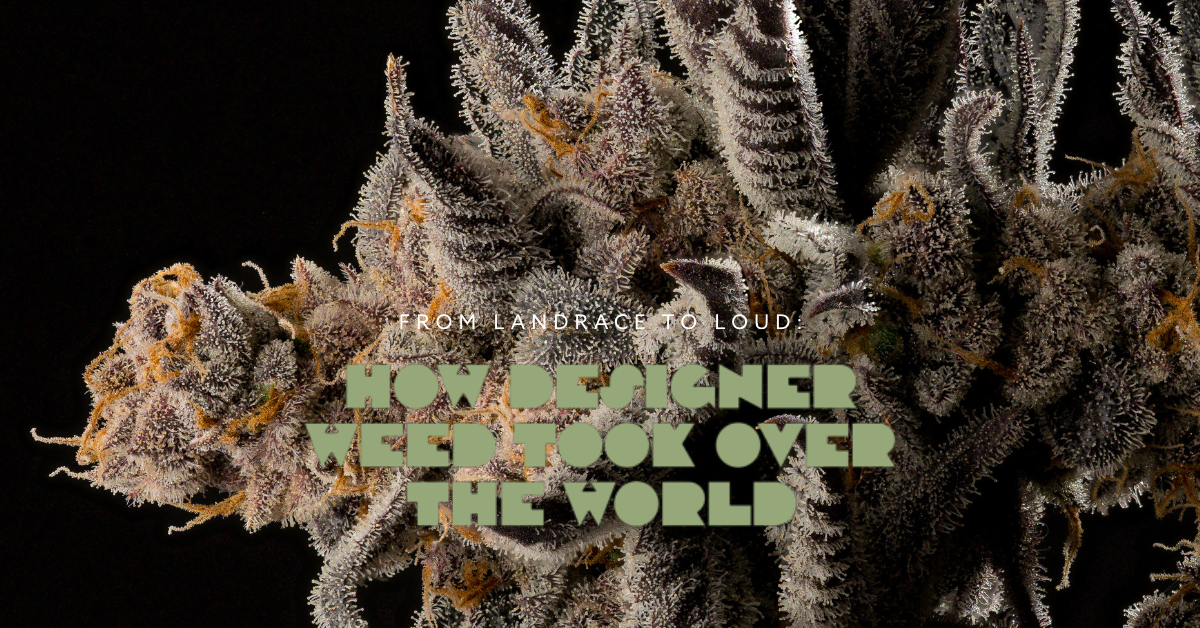
Shelf after shelf of flower with bud density like a black hole and neon hues across the color spectrum, punctuated by blazing orange hairs. Frosty trichomes glisten, beckoning like Sirens from Greek mythology. Flavor notes bomb like a dessert drenched with diesel and set on fire at a 3-star Michelin eatery.
It used to be welcome to the jungle. Now, it’s welcome to the era of designer weed, where you can have it every way, every day. This is not the result of that Darwinian evolution thing. Natural selection has nothing to do with it.
Today’s weed is genetically engineered by generations of breeders, all on a quest to create the holiest of holy grails: the next legendary strain.
Before Designer Dope: The Era of Landrace Strains
Humans have blazed for thousands of years. Archaeological digs trace use back to ancient China, and historical texts reference the Devil’s Lettuce as early as 2900 BCE.
Back then, cannabis was a plant that grew naturally on whatever continent you called home. Today, we call these landrace strains.
A landrace strain is cannabis that evolved naturally in a specific geographic region, adapting to its environment. No crossbreeding, tissue culture, testing labs, or state-of-the-art indoor facilities. No intense manipulation whatsoever. Just nature being nature and people being people.
Over centuries, some pretty amazing landrace strains developed across the globe.
Landrace Strains Around the World
Afghanistan & Pakistan: The Hindu Kush Mountains
This is indica bedrock. If you’re talking about the purest, most iconic landrace from the Hindu Kush region, it’s Hindu Kush itself, or Afghan Kush when sourced from the Afghan side of the mountains.
Origin
The Hindu Kush mountains stretch between Afghanistan and Pakistan. The high altitude, freezing nights, and dry air forced this plant to evolve thick stalks, broad leaves, and heavy resin production for protection. That resin is also the foundation of traditional hashish culture.
Genetics
100% indica. Unhybridized (in true form).
Parent to countless strains. Without Hindu Kush, you don’t get OG Kush, Northern Lights, or most modern indica lines.
Aroma & Flavor
Earthy with notes of sandalwood. Spicy hash with slight sweetness and a nose like pressed hash bricks in dry mountain air.
Effects
Deep body sedation and muscle relaxation with a calm, grounded mental state. This ain’t “Instagram indica.” This is sit by the fire, slow your pulse, sleep like a warrior after battle indica.
Global Impact
Hindu Kush built the global hash trade and shaped modern cannabis breeding. Every “designer” indica owes tribute to this strain. If you want pure, uncut mountain DNA, this is the one.
Africa: Durban Poison
If the Hindu Kush is the king of the mountain indicas, Durban Poison is the war chief of African sativas. Born in and around the port city of Durban, this pure sativa evolved under intense sun, coastal humidity, and long growing seasons. No hybrid tinkering. No designer lab coats. Just raw African genetics shaped by climate and time.
Genetics & Structure
100% Sativa. Tall, fast-growing, with long, spear-shaped colas. Thrives outdoors in hot, sunny climates. Durban Poison stretches aggressively. This is not a squat mountain bush. It’s a solar panel built to harvest the African Sun.
Aroma & Flavor
Sweet anise with black licorice, earthy pine, and a subtle citrus peel. That sharp, spicy sweetness comes from high levels of terpinolene, giving it a crisp, energetic, aromatic profile that stands apart from modern candy-heavy hybrids.
Effects
This is not couch-lock. This is clarity, uplifting, and cerebral. Creative, focused, and energetic without paranoia (for most). Durban became a backbone genetic in modern breeding because it delivers clean, functional elevation. Many modern sativas and hybrids trace their lineage back to this South African powerhouse.
Global Impact
Durban Poison was one of the first African landraces to gain serious global recognition. It proved that:
- Not all cannabis has to be sedating.
- Tropical genetics could thrive outside its origins.
- Pure sativas could be commercially viable.
It later influenced classics like Girl Scout Cookies and countless modern cultivars seeking that sharp, uplifting edge. If Hindu Kush represents stoic mountain resilience, Durban Poison represents sun-soaked movement and momentum.
Thailand: Legendary Thai Stick
Before “designer weed,” before candy strains with cartoon packaging, there was Thai. And it changed everything. Hindu Kush forged indicas in the mountains, and Durban carved speed in the savanna while Thailand built rocket fuel in the jungle.
In the 1960s and 70s, “Thai Stick” became mythical. The buds were carefully wrapped around bamboo sticks, bound with hemp fiber, and sometimes dipped in hash oil. They were exported during the Vietnam War era and became some of the most coveted cannabis strains in the U.S.
If you talk to old-school smokers, they’ll tell you: Thai wasn’t just strong. It was a high like watching a perfect sunset under a palm tree on a beach in paradise.
Origin
Thailand’s jungle. This landrace evolved in hot, humid, near-equatorial conditions. That environment selected for: very tall plants (10–15+ feet outdoors), long flowering times (12–16+ weeks), and airy, spear-shaped buds for mold resistance. This is pure tropical sativa expression, built for sun, humidity, and survival.
Effects
True Thai landrace is known for intense cerebral stimulation, euphoria, creativity, and focus without heaviness. This wasn’t couchlock. This was jungle caffeine. It’s the genetic backbone of many modern “energetic” strains.
Global Impact
Without Thai, modern sativa breeding doesn’t look the same. Thai genetics became foundational in Western breeding. It influenced Early Haze lines and Skunk hybrids. This strain brought a complete terpene profile and clear-headed potency to a world that had never seen anything like it.
If Hindu Kush is the shield and Durban is the spear, Thai is the arrow. Pure jungle energy.
The Rise of Designer Weed & The Fall of Landrace Strains
These landrace strains are genetic bedrock. The source code. For thousands of years, cannabis evolved as glaciers moved. Slowly, over thousands of years.
But as good as all those strains are, cannabis breeders took that code and asked: Can we make this louder? Gassier? Sweeter? Fruiter? Frostier? More cerebral? More relaxing?
They saw a world of limitless possibilities with modern designer weed. Humans started playing God. Selective breeding accelerated everything as cultivators began crossing strains to accentuate desirable traits. The era of designer weed was born.
At this very moment, breeders across the globe are hunting for the next strain that will dominate menus, flood Instagram feeds, and live rent-free in your head as the best smoke you ever blazed.
It’s not just about potency, either. For the true connoisseur, obsessing over THC percentages completely misses the point. The strains that truly define eras aren’t just strong. They’re distinctive. Unmistakable for anything other than what they are. Flowers that win cannabis cups are beautifully unique. This is art, not science.
What makes a strain the weed of legend is like describing the Mona Lisa’s smile. Sure, we can find the words. But they never quite capture the feeling.
A 34% THC strain with a one-note high and no legs? Forgettable. A 19% strain that smells like you cracked open a fuel tank inside a fruit market during a monsoon in a rainforest with a groovy high that takes you on a magical mystery tour? Legend.
The number of strains that we have today that are legendary is too long to list here. But here are a few with the personality, presence, and identity to make them worthy of attention.
Are Pure Landraces Still Out There?
Kind of. Maybe. Depends who you ask.
The landrace strains featured in this article have undergone some level of selective breeding since they were first cultivated by humans. My question: once landrace evolution is so impacted by humans, can a strain still be characterized as landrace?
For this writer, the answer is no. Human intervention changes the plant’s natural characteristics.
Where Cannabis Strains Are Headed
The evolution of designer weed isn’t slowing down. It’s accelerating. We’re seeing more hyper-specific terpene breeding, rare cannabinoid exploration, precision pheno-hunting, and boutique, small-batch drops than ever.
Breeders aren’t just growing plants anymore. They’re crafting experiences. The weed that once grew wild and free has become a curated art form. Imagine if those Fred Flintsoners could crack open a jar of purps sparkling as if dusted in diamonds, smelling like a gas station baked a pie. They’d probably think it was sorcery.
Maybe it is.
Are cannabis breeders wizards, casting spells with every new cultivar that holds us mesmerized? Maybe.
Regardless, the golden age of designer weed is going down, and I’m here for it.
Subscribe to Fat Nugs Magazine!
Love this article? Show your support for Fat Nugs with a magazine subscription!
As a fully independent media organization, Fat Nugs relies on the grassroots support of individuals like you to continue to write and share these articles. Every subscription helps us keep bringing you the unbiased, broad-ranging cannabis, hemp, and psychedelics articles like these.