In a regulated electricity market, there’s one company that generates the power, delivers it, and bills for it. The price is set by a public utility commission. But roughly two-thirds of U.S. states, plus D.C., have deregulated their electricity markets, which means the utility’s role is legally split in two. The “poles and wires” side — delivery, metering, outage response — stays regulated and stays with the utility, while the actual supply of electricity, the generation itself, is opened up to competition.
In these markets, a business can buy its supply from any licensed retail supplier it chooses, at a negotiated rate, while the utility still delivers it over the same wires and still handles the same outage calls. The catch is that if a customer never chooses a supplier, they’re automatically defaulted onto the utility’s standard offer or “price-to-compare” rate — a variable rate that resets periodically and moves with the wholesale market.
Most commercial customers never realize they were ever supposed to make a choice, so they simply stay on that default rate indefinitely, paying whatever it happens to be each month.
What a Power Broker Does for Commercial Cannabis Operations
Procurement and Supply
A power broker’s first job is procurement: shopping the competitive market, comparing supplier offers, and locking in a fixed-rate contract timed to avoid buying at a seasonal or market peak — turning an unmanaged variable cost into a predictable, negotiated one.
Supply is only one line on the bill, though, and it’s not the only one a power broker can influence. The other major lever is demand itself, through demand management and demand response.
Demand
Here’s the mechanism: in most deregulated markets, a portion of what a commercial or industrial customer pays isn’t based on how much energy they use over a month — it’s based on how much power they were pulling during the specific hour, or even the specific 5-15 minute interval, when the regional grid operator (PJM, ERCOT, MISO, NYISO, and so on) hit its own annual or monthly peak demand. This is called a coincident peak, and it’s how capacity and transmission charges get allocated back to individual customers — a facility’s peak-hour draw during that narrow window can set its capacity cost obligation for the entire following year.
Demand response programs pay or credit customers for voluntarily reducing load during those forecasted peak events, and demand management more broadly means identifying a facility’s own peak usage patterns and shifting non-critical load — a chiller cycle, a batch process, a charging schedule — away from system peak hours. Done well, this doesn’t just lower a bill; it can meaningfully reduce the fixed capacity charge a facility is locked into for the next twelve months.
Efficiency
The third lever is efficiency. It’s the one most businesses leave entirely on the table because chasing it takes specialized knowledge most operators don’t have time to build. Utilities and state energy offices fund efficiency programs — for lighting retrofits, HVAC and refrigeration upgrades, variable frequency drives, building controls, and process equipment — as a cheaper alternative to building new generation and transmission capacity.
These programs typically pay per unit of energy saved (per kWh or per kW of demand reduced), have specific equipment eligibility requirements, application windows, and pre-approval steps, and the paperwork alone is enough to discourage most facility managers from applying.
A broker who tracks these programs by territory can identify which planned upgrades actually qualify, help structure the application so it isn’t rejected on a technicality, and turn what would have been a straight capital expense into one partially offset by a rebate.
Why Power Brokers Matter
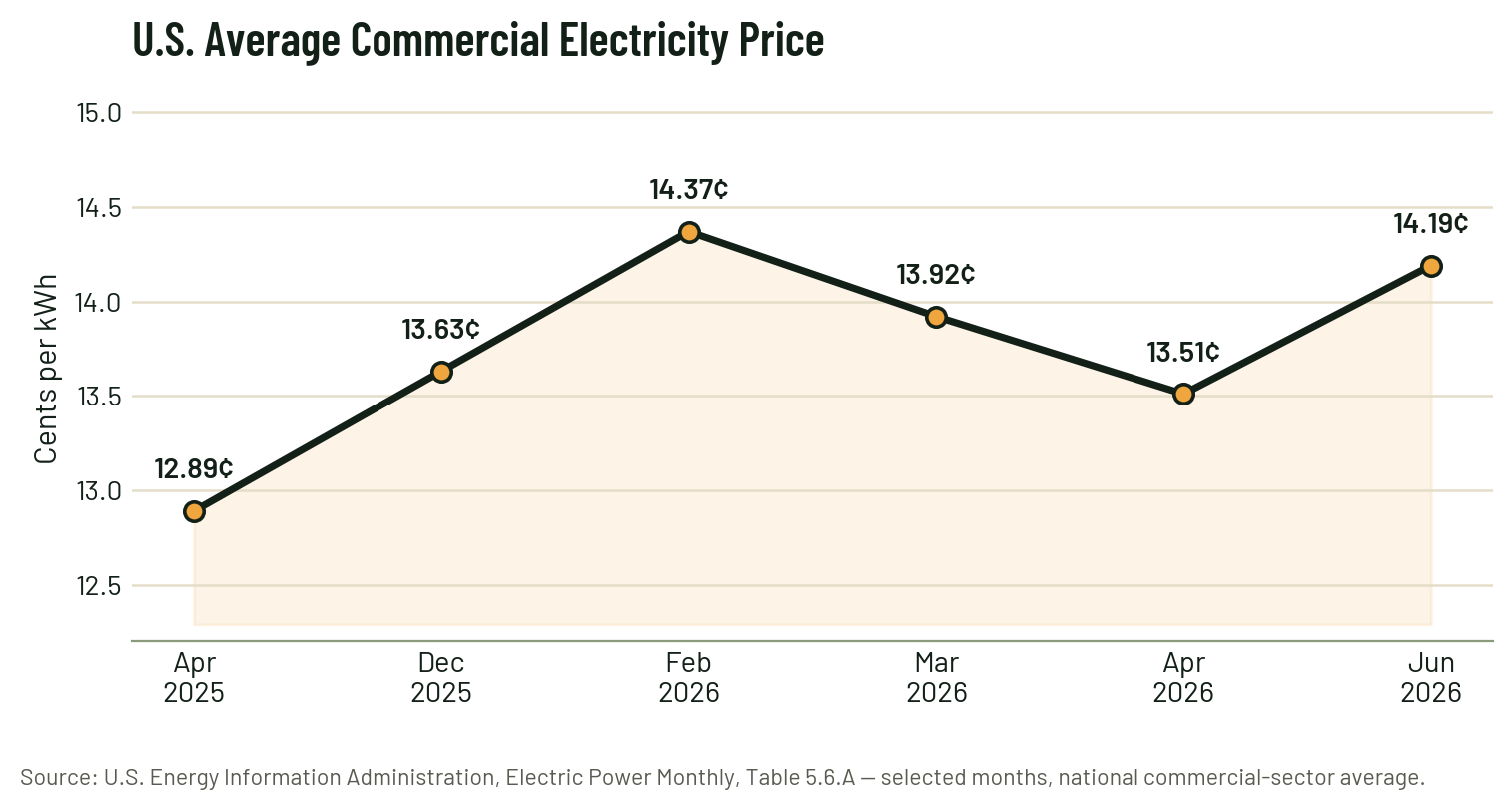
All three of these levers matter more today than they did even a few years ago, because the underlying cost of electricity is shifting under everyone’s feet. The rapid buildout of data centers across the country is placing enormous new load on regional grids — some single data center campuses now draw as much power as a mid-sized city — and grid operators and utilities are responding with new transmission investment, higher capacity auction clearing prices, and, in some territories, entirely new surcharge line items to fund the infrastructure needed to serve that growth.
Those costs get socialized: they’re spread across the entire customer base on a given utility’s system, not billed directly to the data center operators alone, which means a small manufacturer, a multi-site retailer, or a cultivation facility with no connection to a data center down the road is still paying a share of that buildout through rising capacity charges and delivery surcharges.
Most customers never notice this happening because it doesn’t show up as a single dramatic price spike — it shows up gradually, buried in line items most people don’t read closely. This is exactly where the first two levers combine to do real work: locking in supply before those cost increases are priced in, and controlling a facility’s own peak demand so it isn’t compounding a systemic cost increase with an uncontrolled peak of its own.
U.S. average commercial electricity price, selected months. Source: U.S. EIA, Electric Power Monthly, Table 5.6.A.
The mistake most companies make is treating a power contract the way they’d treat a water bill — something to set up once and never look at again. That might have worked when rates were flat and predictable, but it doesn’t hold up in a market where capacity auction results, fuel prices, weather-driven demand, and grid buildout are moving constantly, and where new efficiency programs open and close on their own schedules.
Energy costs deserve the same ongoing scrutiny as any other major expense line: a recurring monthly review of usage patterns, contract expiration timing, rate movement, and available incentive programs — not a single contract signed three years ago and never revisited. A facility’s own load profile changes too, as equipment is added, processes shift, or operating hours change, and a contract or demand strategy built around last year’s usage may no longer fit this year’s.
That’s the real case for having a broker like On Point Power in your corner: not a one-time transaction, but a standing advocate actively managing all three levers — supply, demand, and efficiency — on an ongoing basis. In a market where most customers are simply paying whatever number shows up on the bill each month, that continuous oversight is the difference
About the Author
Jim Kordoban is the founder and CEO of On Point Power, a power management consulting firm that specializes in the cannabis industry.
Subscribe to Fat Nugs Magazine!
Love this article? Show your support for Fat Nugs with a magazine subscription!
As a fully independent media organization, Fat Nugs relies on the grassroots support of individuals like you to continue to write and share these articles. Every subscription helps us keep bringing you the unbiased, broad-ranging cannabis, hemp, and psychedelics articles like these.