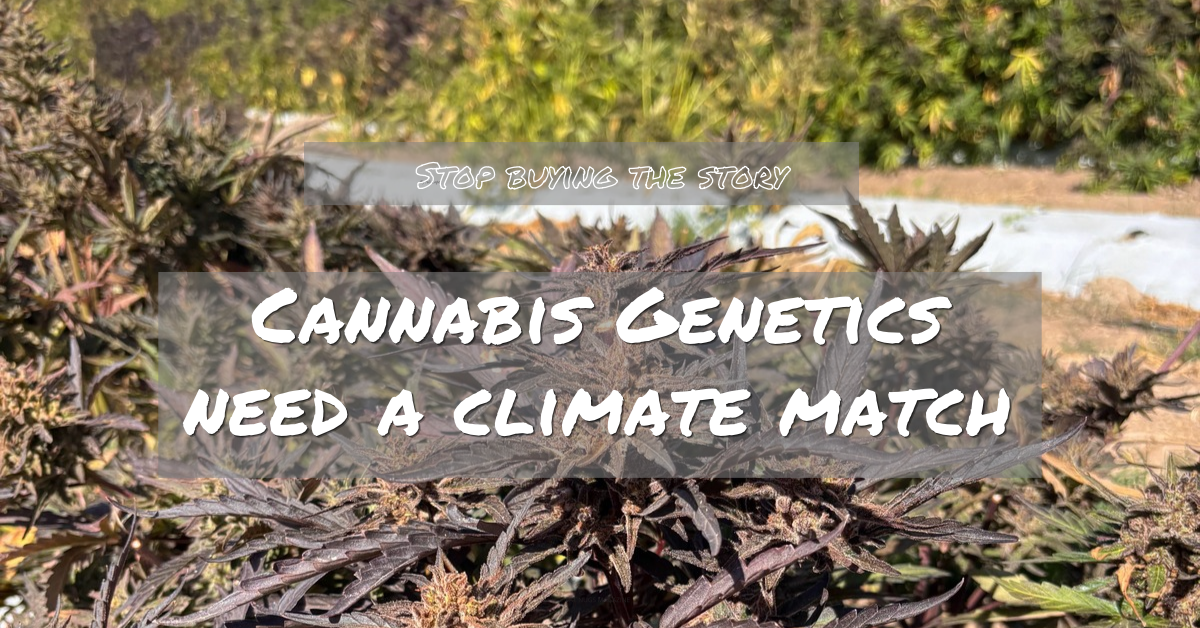
Every one of these factors influences how a plant grows, flowers and finishes. The same cultivar can produce completely different plants depending on where it is grown. That is not a failure of genetics. It is biology.
A cultivar’s reputation is not a climate profile. A plant that performs exceptionally in a dry, controlled environment may struggle in a warm and humid facility. A genetic selected under cool nights may stretch, flower unevenly, or express different quality characteristics when exposed to warmer overnight temperatures. A cultivar that looks outstanding under one lighting system or irrigation strategy may require major adjustments elsewhere.
I saw these differences repeatedly while working in three very different Australian cultivation environments. In some cases, the chosen genetics were simply not suited to the climate or production system. The teams could adjust the environment, but they were often trying to correct a genetic mismatch rather than working with a plant that naturally suited the site.
Why Cannabis Genetics Matter More in Medical Cannabis
For home growers, inconsistency can be disappointing. For licensed medical producers, inconsistency is expensive. Patients expect repeatable medicine. Manufacturers rely on consistent inputs. Quality teams need stable cannabinoid and terpene profiles, while commercial teams depend on reliable supply.
When genetics do not suit the production environment, every department inherits the consequences. Cultivation spends more time correcting growth issues. Quality assurance works harder to maintain specifications. Processing deals with greater variability. Commercial teams struggle with continuity.
In the facilities I worked in, poor genetic selection contributed to failed crops, inconsistent crop performance, and additional pressure on the wider production system. A cultivar may survive and produce flower, but that does not mean it is commercially suitable.
The real questions are more demanding:
- Can it perform consistently?
- Can it meet quality specifications?
- Can it be grown economically?
- Can it produce uniform batches?
- Can it be managed with the facility’s available environmental controls?
- Can the result be repeated across multiple crop cycles?
The problem often begins with a single decision: selecting genetics based on reputation rather than suitability.
Australia Isn’t One Climate
Australia is often spoken about as though it is a single growing region. It isn’t.
While Australia does not contain a true equatorial zone, parts of the far north can produce equatorial-like conditions, including persistent heat, high humidity, heavy seasonal rainfall and relatively limited variation in day length. From there, the country moves through tropical monsoonal conditions in the far north, humid subtropical districts across south-east Queensland and northern New South Wales, the arid and semi-arid interior, the dry Mediterranean and semi-arid environments found across much of Western Australia, Mediterranean zones in the south-west and southern coast, and finally cool-temperate coastal regions and alpine highlands in the south-east.
Parts of Western Australia may offer a more natural environmental match for genetics selected in California. Many
Californian cultivation regions share characteristics with parts of Western Australia, including relatively dry conditions, lower humidity and Mediterranean-style seasonal patterns. This does not mean that every California cultivar will perform well in Western Australia, but it may give those genetics a more suitable starting point than they would have in a persistently warm and humid environment.
Florida provides a useful contrast. Many areas of Florida experience warm temperatures, high humidity, strong seasonal rainfall and coastal conditions. Genetics selected and proven in similar environments may therefore have a better starting point in warm, humid coastal regions of Australia, including parts of coastal Queensland and northern New South Wales.
That does not mean every Florida cultivar will automatically perform well in Brisbane, Caniaba or another East Coast location. Florida itself contains regional differences, and cultivar performance still depends on the specific temperature profile, humidity load, light conditions, airflow, irrigation system and disease pressure of the production site. However, genetics developed under comparable warm and humid conditions may be more naturally prepared for those pressures than varieties selected in a dry inland or Mediterranean environment.
These climate types are not neatly confined to fixed boundaries. Australia contains countless microclimates shaped by elevation, distance from the coast, topography, rainfall patterns, prevailing winds, soil, vegetation and local weather systems. That creates an even wider range of growing conditions than a national climate map suggests.
Brisbane and Caniaba are good examples. Both are, broadly, warm and humid, but their growing conditions are not identical. Caniaba experiences colder overnight temperatures and colder winters, while Brisbane generally maintains warmer conditions. Those differences can influence plant structure, flowering behaviour, finishing times, disease risk, and environmental-control requirements.
Western Australia provides a contrasting example. A cultivar that performs well in a dry, low-humidity environment may not respond in the same way when moved into a warm, humid facility. The reverse can also be true: genetics accustomed to persistent humidity may require different environmental management and irrigation strategies in a dry climate.
Armidale presents a completely different challenge. Its elevation and colder conditions create a cool, highland environment that can resemble an almost alpine climate compared with warmer northern locations.
Each site brings its own temperature profile, humidity load, seasonal pattern, light conditions, water characteristics, and disease pressure. Microclimates add further variation within those broader categories. A cultivation strategy that performs exceptionally well in one location may require significant changes only a few hundred kilometres away.
Climate is not simply about whether somewhere is warm or cool. It is the complete combination of environmental conditions a plant experiences throughout its lifecycle.
Introducing the Twin Climate Concept
Rather than asking, “Is this a good genetic?” I believe the better question is:
“Where does this genetic consistently perform well, and how closely does our environment resemble that one?”
I call this the *Twin Climate* approach. A twin climate is not an exact copy of another location. It is a practical comparison between environments that share the conditions most likely to influence cultivar performance.
These include:
- Day and night temperatures
- Humidity patterns
- Seasonal rainfall and moisture persistence
- Solar intensity and photoperiod
- Diurnal temperature range
- Water chemistry
- Air movement
- Disease and pest pressure
- The capability of the production system itself
It is the combination of these factors, not a single climate statistic, that determines whether a cultivar can express its potential.
My work across Armidale, Brisbane and Caniaba showed me that a genetic suited to one Australian production environment could behave very differently in another. The differences were not always obvious during early growth. Problems often appeared later, during flowering and finishing, when plant structure, humidity and airflow became more critical.
That is when a genetic mismatch can become expensive.
A Cultivar Doesn’t Just Cross a Border. It Enters a Different System
When a cultivar arrives in Australia, it is not simply entering a new country. It is entering an entirely different production ecosystem.
The breeder who developed it may have spent years selecting that plant under very specific conditions: particular temperatures, humidity levels, lighting strategies, irrigation water, and nutrient programs. Its reputation may have been built in a boutique indoor facility in California, a commercial greenhouse in British Columbia, or an outdoor farm in southern Oregon.
By the time that same genetic reaches an Australian cultivation facility, almost everything around it may have changed. The HVAC system is different. The irrigation water may have a different mineral profile. Disease pressures change. Staff have different cultivation practices. Seasonal conditions are different. Commercial expectations are different.
The plant will probably still grow. But that is a very low bar.
For a regulated medical producer, the real question is not, “Can we grow it?” It is: “Can we grow it consistently, economically and at commercial scale?”
That is where many celebrated cultivars begin to separate themselves. Some genetics produce incredible flowers or extracts, but only when given constant attention. Others require intensive environmental control or unusually high labour inputs to perform at their best.
A genuinely commercial cultivar is different. It performs reliably under the conditions that actually exist inside the facility. The differences often appear in details that never make it into breeder catalogues or social-media posts:
- Does the plant remain structurally manageable through late flower?
- Can it tolerate normal temperature and humidity fluctuations?
- Is its flower structure suited to the airflow available?
- Does it remain clean when humidity is hardest to control?
- Does its flowering time align with the production schedule?
- Does it retain its terpene profile and cannabinoid consistency after drying and storage?
- Can it produce uniform batches that consistently meet downstream specifications?
These are not glamorous questions. They are operational questions, and in medical cannabis they can be the difference between a cultivar that is exciting and one that is genuinely valuable.
Cannabis Genetics Carry an Environmental History
Every breeder selects plants under particular environmental conditions. Whether intentional or not, those environments shape future generations. A cultivar repeatedly selected in a dry inland climate is being filtered by those conditions. One developed in a tightly controlled indoor facility may respond very differently when exposed to greater environmental variability. That is why provenance matters.
A cultivar’s name tells only part of the story. Growers should also ask:
- Where was it selected?
- How many environments has it been trialled in?
- How stable is its performance?
- How does it respond to humidity?
- How does it perform under warmer or colder nights?
- How consistent is it over multiple harvests?
- Was it selected for flower, extraction, yield, resilience or another purpose?
Those questions provide more useful information than marketing alone. The same principle applies to breeding. If Australian breeding programs want to produce cultivars that perform reliably across the country, they need to select in more than one environment. A plant that performs well in one facility may not be the best parent for every region or production system.
Breeding should consider not only cannabinoid content and appearance, but also environmental adaptability, uniformity, disease resilience, flowering response, plant structure and post-harvest stability.
From Hype to Evidence
Australia has an opportunity to develop a more mature approach to genetic selection. Instead of asking which cultivar is trending overseas, operators can begin building evidence.
That means documenting environmental conditions, recording cultivar performance, tracking morphology, flowering times, disease pressure, quality metrics and post-harvest outcomes, then comparing results over multiple production cycles.
This is the kind of information I have collected through conversations and data from growers across Australia, covering the different climates and growing environments the country has to offer. Those observations are what moved me towards this area of work.
I wanted to understand whether the problems I saw in individual facilities were isolated incidents or part of a wider pattern. The more I compared experiences across different regions, the clearer the pattern became: genetics were often being selected because they were fashionable overseas, while the climate and production environment received less attention than they deserved.