
Welcome to Ask A Neuroscientist, a series on Fat Nugs that takes a scientific lens on some of the biggest and juiciest questions around how cannabis works in the body. This article explores the intersection of community and cannabis, and why getting alone feels different than getting high together.
Built for Company: What Your Endocannabinoid System Knows About Getting High Together
Ask a longtime smoker about their best sessions and they rarely describe a night alone. They talk about a circle on a porch and a joke that got funnier every time the joint came around. The cannabis community has always treated sharing as part of the ritual. Neuroscience has good reason to take that seriously, though not quite the reason most people expect.
Your brain’s own cannabis-like chemicals seem to be part of how company feels good in the first place. Yet the evidence that a shared high is chemically stronger than a solo one is thin. The research points somewhere more useful. Why you reach for the plant, and whether you reach for it alone, is linked to how cannabis treats you over time.
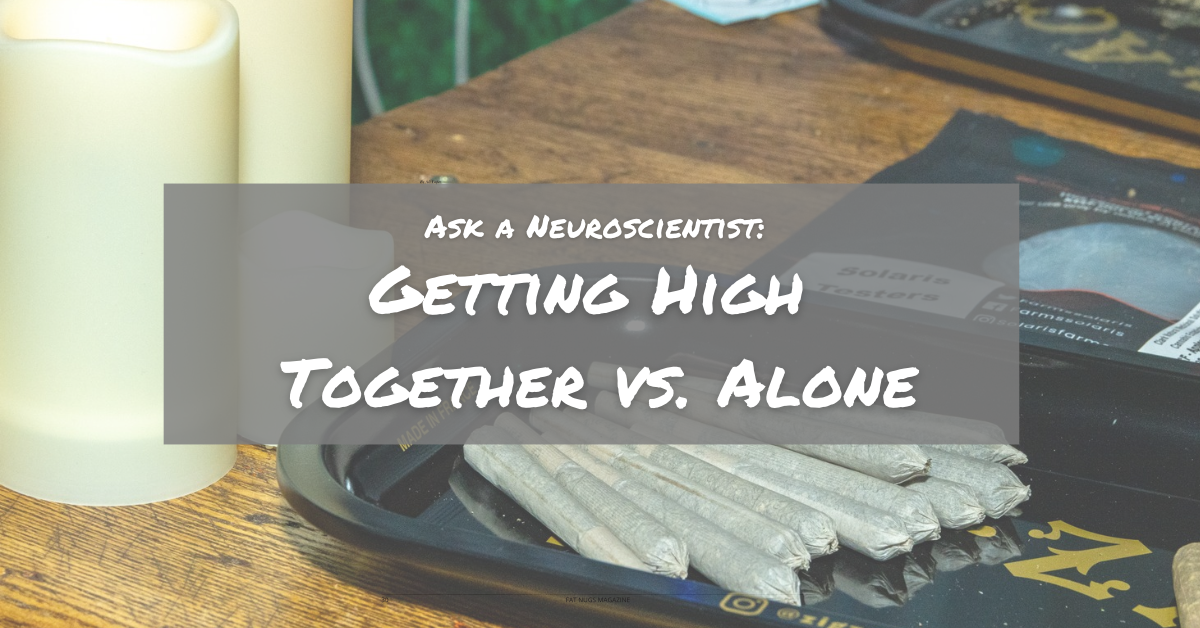
Ask a Neuroscientist: Getting High Together vs. Alone
The Chemistry of Company: A Rodent Study
Your body runs a signaling network called the endocannabinoid system. It uses molecules the body makes on its own, mainly anandamide and 2-AG (2-arachidonoylglycerol). These act on CB1 receptors, the same receptors THC binds to when you get high.
In 2015, Daniele Piomelli’s lab at UC Irvine showed that this system helps make social contact rewarding (at least in mice. (Wei et al., 2015)
In young mice, time with others raised anandamide in the hub of the brain’s reward circuit. Time alone lowered it. When the team blocked CB1 receptors, mice no longer preferred the place where they had met other mice. The trigger turned out to be oxytocin, a hormone tied to bonding. When the team blocked oxytocin, the anandamide spike never came. When they switched on oxytocin cells, it did.
A follow-up study found a similar pattern with the brain’s other major endocannabinoid. Social contact pushed 2-AG to 183% of the level seen in isolated mice (Wei et al., 2016). Male mice engineered to break down 2-AG faster did not learn to prefer places linked to company or to high-fat food. Their response to cocaine stayed intact, which suggests this system is tuned to natural rewards like friends and food.
Rats tell a similar story. In adolescent rats, play with other rats raised anandamide in the amygdala, a region that helps detect threats, and in the brain’s reward circuit (Trezza et al., 2012). Another team found that endocannabinoid and opioid signals need each other to boost play (Manduca et al., 2016). Social reward appears to rest on several systems working together, with endocannabinoids as one of them.
Keep two cautions in mind. First, every study in this section used rodents. In these experiments, “social reward” means an animal choosing a spot where it met others, which is a long way from a human feeling of connection. Second, the details matter. Two drugs designed to raise anandamide had opposite effects on rat play, likely because one also hit other targets (Trezza & Vanderschuren, 2009).
What THC Does to the Social Brain in Humans
THC is a blunter tool than the body’s own signals. In adolescent rats, drugs that switch on cannabinoid receptors directly tend to reduce social play, while boosting natural anandamide can increase it (Trezza & Vanderschuren, 2008).
Human studies are fewer and smaller. In one brain-imaging experiment, 16 recreational users took a low oral dose of THC (7.5 mg) or a placebo (Phan et al., 2008). On THC, the amygdala stopped reacting more strongly to angry and fearful faces than to happy ones. THC did not change how anxious people said they felt, though, and one small dose in 16 people cannot tell us how this plays out at a real party.
One controlled study tested real cannabis on social behavior directly. In a 1987 residential lab study, 12 men spent more time socializing in small groups after smoking active marijuana than after smoking placebo, though the effect varied from person to person and from group to group (Foltin et al., 1987).
Another line of research looked at social pain. Across four studies, loneliness and being left out in a computer game were less strongly tied to hurt feelings among people who used cannabis (Deckman et al., 2014). The researchers measured cannabis use rather than handing it out. So the users may have differed from non-users in other ways that explain the result.
The Group High, Put to the Test
If endocannabinoids help make company rewarding, company might also change the high. So far, the best summary of the evidence has not found a reliable effect.
A 2024 systematic review and meta-analysis covered 29 studies on how setting shapes cannabis effects (Ayyagari et al., 2024). Where people used, who they used with, and what they expected did not significantly predict how high they reported feeling. Lab studies showed larger context effects than studies that tracked people in daily life. The authors called the research methodologically weak and cautioned that it is too early to rule out context effects.
Only a handful of lab studies have compared smoking alone with getting high together, and most are decades old.
- In a 1971 study of 100 men, those who smoked in small groups rated their euphoria higher than those who smoked alone.
- A 1981 study had people smoke alone, with friends, or with strangers, and found no difference in how high they felt (Jones, 1971; Stark-Adamec et al., 1981; both as cited in Ayyagari et al., 2024).
- Several daily-life studies found that people felt higher when they used with others, though people may also use more in company (Ayyagari et al., 2024).
The animal and human findings may also diverge because they measure different things. The mouse studies track the body’s own brief signals and an animal’s choice of place. The human studies track people who took THC and rated how high they felt.
A study of placebo psychedelics shows how strong social cues can be (Olson et al., 2020). At a staged party, 61% of 33 students given a placebo reported feeling drug effects. Actors in on the setup acted out the drug’s effects to build expectations. That study did not involve cannabis, so treat it as an analogy. It suggests a group can shape what people believe they feel, even when the chemistry stays the same.
What Smoking Alone Predicts
The stronger human evidence concerns what solo cannabis use predicts.
Researchers followed 447 teens who used cannabis, most recruited from treatment programs, to age 25 (Creswell et al., 2015). Teens who often used alone had more symptoms of cannabis use disorder (CUD) at age 25, even after the researchers accounted for how often they used. That link vanished, though, once the researchers also accounted for the CUD symptoms teens already had. Solo use seemed to flag an existing problem rather than predict a new one.
Studies of adults suggest a reason:
- In a Canadian sample of 188 people, solitary users more often reported using to cope or self-medicate (Spinella et al., 2019). They also had more dependence symptoms.
- Among 276 undergraduates, those with more social anxiety used alone more often, while their social use did not rise (Buckner et al., 2016). How often they used alone statistically accounted for the link between social anxiety and cannabis problems.
- A study of 387 college students found that solo use was linked to more negative consequences, partly through coping motives (Okey et al., 2022).
Daily-life data point the same way:
- In a phone-based study of 200 adults, negative mood ran higher when people used alone than when they used with others (Denson et al., 2023).
- Among 854 French college students, those who mostly smoked alone had more CUD symptoms, even after accounting for how often they used (Chassagne et al., 2024).
- Among Norwegian high school students, those who used alone had roughly twice the odds of several kinds of harm (Bretteville-Jensen & Burdzovic Andreas, 2026).
- Company is no guarantee of safety, though. In one daily study, both solo and social use predicted more problems the next day (Wedel, 2024).
A 2024 review pulls this together. Coping motives are consistently linked to heavy use, problems, and CUD (Gex et al., 2024). The link for social motives is inconsistent. All of these studies are correlational.
The Messier Human Picture of Getting High Together vs Alone
Genetics
Genetics adds little so far. A common variant of the FAAH gene, which makes the enzyme that breaks down anandamide, leaves carriers with more anandamide. Studies of that variant measured fear and anxiety rather than social behavior, and their results conflict (Conzelmann et al., 2012; Dincheva et al., 2015).
Lonliness
Loneliness does not map neatly onto the mouse findings.
In a study of 44 grieving older adults and 20 non-grieving controls, the loneliest grievers had higher anandamide in their blood than the controls (Kang et al., 2021). Within the grieving group, that link faded once the researchers accounted for depression. That runs against a simple “isolation drains your endocannabinoids” story. Blood levels also do not reliably reflect what happens in the brain.
Loneliness may also come before heavier use. In a study that followed 4,407 young adults, those who felt lonelier in their early twenties were more likely to use cannabis often, and to have CUD, a few years later (Rhew et al., 2025).
Getting High Together vs. Alone
The useful question when consuming cannabis in any setting is “Why am I reaching for this?”
Using to connect and using to escape distress are different patterns, and the research ties problems to the second one. If you notice that most of your solo sessions follow a bad day, that pattern is worth noticing, and worth raising with a clinician if it worries you.
For the community, the biggest finding may be the gap. Whether a shared high differs from a solo one is still an open question. The few lab tests are small and decades old, and daily-life studies cannot tell whether people feel higher in company or simply smoke more.
Consumer-led groups such as MoreBetter and the Network of Applied Pharmacognosy already collect real-world data on how people use cannabis (Reilly-Chevalier, 2025). Phone-based studies already ask people who they are with, why they are using, and how they feel.
What is still missing is a study that also measures how much people use, so the effect of company can be separated from the amount smoked. That study would test whether the circle on your porch changes your high.
Subscribe to Fat Nugs Magazine!
Love this article? Show your support for Fat Nugs with a magazine subscription!
As a fully independent media organization, Fat Nugs relies on the grassroots support of individuals like you to continue to write and share these articles. Every subscription helps us keep bringing you the unbiased, broad-ranging cannabis, hemp, and psychedelics articles like these.
About the Author
RN Collins is the staff writer at Fat Nugs Magazine, as well as 1L at Northeastern University School of Law and a neuroscientist exploring how brain health and the environment intersect. Through her writing, she bridges academic research and science communication to reframe how psychoactive plants and other traditional and alternative medicines are understood. She’s building a career that connects law, technology, and creativity—and welcomes conversations and opportunities across fields that share that vision. Connect with her on LinkedIn!
References
- Ayyagari, M. M., Heim, D., Sumnall, H. R., & Monk, R. L. (2024). Contextual factors associated with subjective effects of cannabis: A systematic review and meta-analysis. Neuroscience & Biobehavioral Reviews, 164, Article 105822. https://doi.org/10.1016/j.neubiorev.2024.105822
- Bretteville-Jensen, A. L., & Burdzovic Andreas, J. (2026). Cannabis use settings matter: National-level prevalence rates, correlates, and consequences of solitary cannabis use among high school students in Norway. Addictive Behaviors, 183, Article 108820. https://doi.org/10.1016/j.addbeh.2026.108820
- Buckner, J. D., Ecker, A. H., & Dean, K. E. (2016). Solitary cannabis use frequency mediates the relationship between social anxiety and cannabis use and related problems. The American Journal on Addictions, 25(2), 99–104. https://doi.org/10.1111/ajad.12339
- Chassagne, J., Raynal, P., Bronchain, J., & Chabrol, H. (2024). Smoking mostly alone as a risk factor for cannabis use disorders and depressive symptoms. International Journal of Mental Health and Addiction, 22, 1761–1770. https://doi.org/10.1007/s11469-022-00956-1
- Conzelmann, A., Reif, A., Jacob, C., Weyers, P., Lesch, K.-P., Lutz, B., & Pauli, P. (2012). A polymorphism in the gene of the endocannabinoid-degrading enzyme FAAH (FAAH C385A) is associated with emotional–motivational reactivity. Psychopharmacology, 224(4), 573–579. https://doi.org/10.1007/s00213-012-2785-y
- Creswell, K. G., Chung, T., Clark, D. B., & Martin, C. S. (2015). Solitary cannabis use in adolescence as a correlate and predictor of cannabis problems. Drug and Alcohol Dependence, 156, 120–125. https://doi.org/10.1016/j.drugalcdep.2015.08.027
- Deckman, T., DeWall, C. N., Way, B., Gilman, R., & Richman, S. (2014). Can marijuana reduce social pain? Social Psychological and Personality Science, 5(2), 131–139. https://doi.org/10.1177/1948550613488949
- Denson, R. K., Hedeker, D., & Mermelstein, R. J. (2023). Association between affect and cannabis use varies by social context. Drug and Alcohol Dependence, 243, Article 109750. https://doi.org/10.1016/j.drugalcdep.2022.109750
- Dincheva, I., Drysdale, A. T., Hartley, C. A., Johnson, D. C., Jing, D., King, E. C., Ra, S., Gray, J. M., Yang, R., DeGruccio, A. M., Huang, C., Cravatt, B. F., Glatt, C. E., Hill, M. N., Casey, B. J., & Lee, F. S. (2015). FAAH genetic variation enhances fronto-amygdala function in mouse and human. Nature Communications, 6, Article 6395. https://doi.org/10.1038/ncomms7395
- Foltin, R. W., Brady, J. V., Fischman, M. W., Emurian, C. S., & Dominitz, J. (1987). Effects of smoked marijuana on social interaction in small groups. Drug and Alcohol Dependence, 20(1), 87–93. https://doi.org/10.1016/0376-8716(87)90079-2
- Gex, K. S., Gückel, T., Wilson, J., Ladd, B. O., & Lee, C. M. (2024). Why people use cannabis and why it matters: A narrative review. Current Addiction Reports, 11(6), 1045–1054. https://doi.org/10.1007/s40429-024-00599-3
- Kang, M., Bohorquez-Montoya, L., McAuliffe, T., Claesges, S. A., Blair, N.-O., Sauber, G., Reynolds, C. F., Hillard, C. J., & Goveas, J. S. (2021). Loneliness, circulating endocannabinoid concentrations, and grief trajectories in bereaved older adults: A longitudinal study. Frontiers in Psychiatry, 12, Article 783187. https://doi.org/10.3389/fpsyt.2021.783187
- Manduca, A., Lassalle, O., Sepers, M., Campolongo, P., Cuomo, V., Marsicano, G., Kieffer, B., Vanderschuren, L. J. M. J., Trezza, V., & Manzoni, O. J. J. (2016). Interacting cannabinoid and opioid receptors in the nucleus accumbens core control adolescent social play. Frontiers in Behavioral Neuroscience, 10, Article 211. https://doi.org/10.3389/fnbeh.2016.00211
- Okey, S. A., Waddell, J. T., & Corbin, W. R. (2022). I smoke alone: Indirect effects of solitary cannabis use on negative consequences through coping motives. Journal of Studies on Alcohol and Drugs, 83(5), 721–730. https://doi.org/10.15288/jsad.21-00200
- Olson, J. A., Suissa-Rocheleau, L., Lifshitz, M., Raz, A., & Veissière, S. P. L. (2020). Tripping on nothing: Placebo psychedelics and contextual factors. Psychopharmacology, 237(5), 1371–1382. https://doi.org/10.1007/s00213-020-05464-5
- Phan, K. L., Angstadt, M., Golden, J., Onyewuenyi, I., Popovska, A., & de Wit, H. (2008). Cannabinoid modulation of amygdala reactivity to social signals of threat in humans. The Journal of Neuroscience, 28(10), 2313–2319. https://doi.org/10.1523/JNEUROSCI.5603-07.2008
- Reilly-Chevalier, J. (2025, April 23). Power to the people: The rise of consumer-based research in cannabis. Fat Nugs Magazine. https://www.fatnugsmag.com/power-to-the-people-the-rise-of-consumer-based-research-in-cannabis/
- Rhew, I. C., Cadigan, J. M., Guttmannova, K., Caouette, J. D., Kuklinski, M. R., & Oesterle, S. (2025). The longitudinal relationship of loneliness with frequency and problematic use of alcohol and cannabis among young adults. Journal of Adolescent Health. Advance online publication. https://doi.org/10.1016/j.jadohealth.2025.06.037
- Spinella, T. C., Stewart, S. H., & Barrett, S. P. (2019). Context matters: Characteristics of solitary versus social cannabis use. Drug and Alcohol Review, 38(3), 316–320. https://doi.org/10.1111/dar.12912
- Trezza, V., Damsteegt, R., Manduca, A., Petrosino, S., Van Kerkhof, L. W. M., Pasterkamp, R. J., Zhou, Y., Campolongo, P., Cuomo, V., Di Marzo, V., & Vanderschuren, L. J. M. J. (2012). Endocannabinoids in amygdala and nucleus accumbens mediate social play reward in adolescent rats. The Journal of Neuroscience, 32(43), 14899–14908. https://doi.org/10.1523/JNEUROSCI.2698-12.2012
- Trezza, V., & Vanderschuren, L. J. M. J. (2008). Bidirectional cannabinoid modulation of social behavior in adolescent rats. Psychopharmacology, 197(2), 217–227. https://doi.org/10.1007/s00213-007-1025-3
- Trezza, V., & Vanderschuren, L. J. M. J. (2009). Divergent effects of anandamide transporter inhibitors with different target selectivity on social play behavior in adolescent rats. Journal of Pharmacology and Experimental Therapeutics, 328(1), 343–350. https://doi.org/10.1124/jpet.108.141069
- Wedel, A. (2024). Me, myself, and high: Momentary precipitants and consequences of solitary cannabis use among emerging adults [Doctoral dissertation, Syracuse University]. SURFACE. https://surface.syr.edu/etd/1981
- Wei, D., Lee, D., Cox, C. D., Karsten, C. A., Peñagarikano, O., Geschwind, D. H., Gall, C. M., & Piomelli, D. (2015). Endocannabinoid signaling mediates oxytocin-driven social reward. Proceedings of the National Academy of Sciences of the United States of America, 112(45), 14084–14089. https://doi.org/10.1073/pnas.1509795112
- Wei, D., Lee, D., Li, D., Daglian, J., Jung, K.-M., & Piomelli, D. (2016). A role for the endocannabinoid 2-arachidonoyl-sn-glycerol for social and high-fat food reward in male mice. Psychopharmacology, 233(10), 1911–1919. https://doi.org/10.1007/s00213-016-4222-0