
This article first appeared in the Flower edition of Fat Nugs Magazine, published in the fall of 2024.
Heading North on Highway 101, driving through Laytonville, I’m surprised to see the only grocery store for this small-town community is not just closed, but is no longer in business.
I am on my way to visit Nikki Lastreto and Swami Chaitanya of Swami Select. The couple has invited my friend Colleen and me up to visit them on their farm in the midst of assessing over 300 jars of flower for the 20th Emerald Cup. The two have presided over the flower competition since The Emerald Cup’s inception: not only will this be the couple’s last year judging, but they have also decided to shut down their cannabis brand and retire.
So much has changed in this area of Northern California, and in the cannabis industry since legalization. Nikki and Swami retiring from Emerald Cup and closing down Swami Select feels like yet another reminder of the ways in which legalization has failed to deliver on its promises.
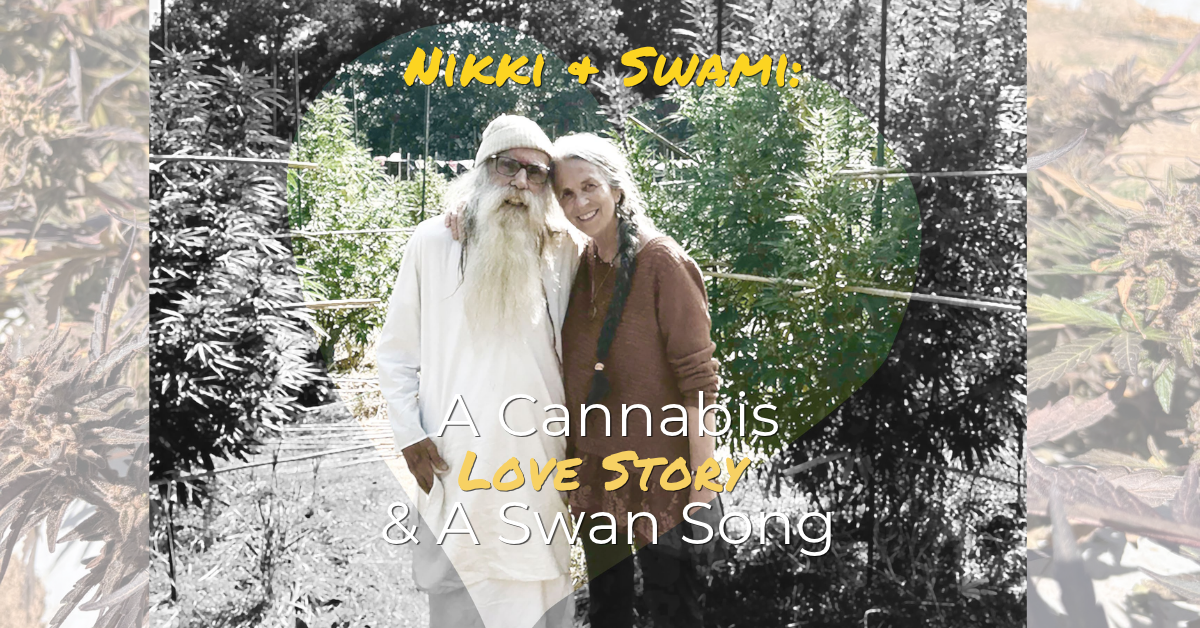
Nikki and Swami
A Cannabis Love Story
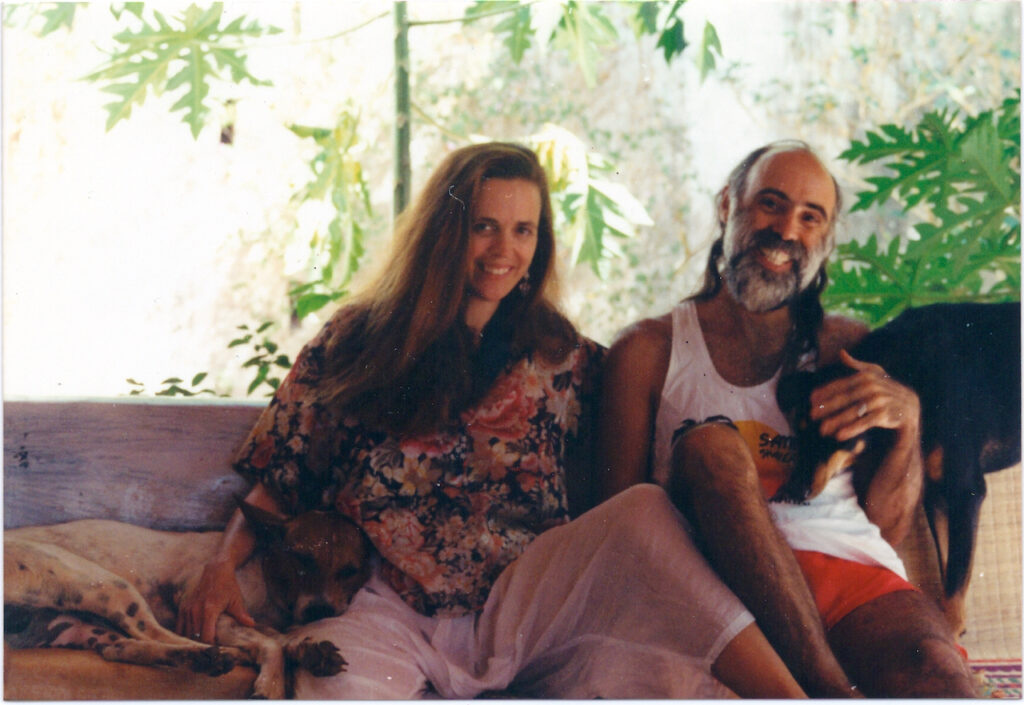
Nikki and Swami met in San Francisco’s North Beach neighborhood in 1969 when Nikki was a young flower child, passing out free food and selling joints with friends, and Swami (William at the time) was part of a commune. They lost touch for several years, reconnected at a reunion of the hippie group, fell in love, and moved in together.
We turn off the 101 and head up a dusty dirt road that snakes through the mountain. Colleen enters the gate code, and we drive past a beautiful meadow. Statues of Ganesh, Shiva, and Buddha stand guard over wildflowers and small garden patches. Their home is a large cabin in the shape of a crescent moon, with balconies, decks, and lots of windows. Inside, your eyes are greeted by something interesting everywhere you look: Indian art, an Egyptian sarcophagus, crystals, photos, mementos from the couple’s travels, and an homage to India.
William and Nikki traveled to India separately, following the “Hippie Trail.” As a couple, they returned together in 1992, living part-time in the mountains of the Himalayas, and the other half of the year at a hippie colony in a house in Goa.
They visited temples and got involved in Hinduism, spending their days doing yoga, reading spiritual texts, and meditating. In 1996, Nikki got the urge to come back to the States. The couple separated: William stayed in India, devoting himself to meditation, and Nikki returned to San Francisco and sold weed.
In 1998, William was initiated into the Jana Yoga branch of Hinduism and became “Swami Chaitanya Vishwakarna.” After his initiation, Swami had to renounce several things: he could only wear one color (white), he had to give up onion and garlic, and he was celibate for 20 years.
On Nikki’s return to India, she and Swami met with Swami Chidananda, their spiritual teacher. He told them to return to America together to create a sanctuary. They returned in March and purchased their land in July of that same year. They got married again and bought their property in Mendocino County.
At the time, the land only had two small cabins. Their original plan was not to grow cannabis. A friend from their old commune in the city brought them some starts, and in 2004 they had their first crop.
This was also the first year of the Emerald Cup, where they were both judges. The event was illegal and risky: half of the 300 people who entered didn’t put their names on their entries – some even wore masks.
We sit around their coffee table in the living room. Jars of cannabis dotted with colored stickers fill the table and surrounding boxes. The couple is busy working their way through all the samples they are tasked with assessing for the Emerald Cup. They have divided up the work efficiently, with Swami rolling and testing the joints, as Nikki keeps track of all the samples and enters their notes into the spreadsheet.
“You’ve both been involved in the Emerald Cup since the beginning; why did you decide to retire?” I ask. 20 years of judging is a long time, they tell me. It’s time to pass the baton.
When Nikki and Swami took up growing, they had to be totally self-sufficient. They put in bridges and solar power, nurtured the living soil, and turned the tiny cabin into their home. They worked with their land and nature and began to develop their craft of growing cannabis in native Mendocino soil under the full sun, moon, and stars.
Through their commitment to regenerative, responsible farming methods, combined with ancient sacred geometry and practices, their flower became highly regarded for its quality.
Swami has always said that he knows when it’s time to harvest because the plants tell him. They both show a supreme love, a devotion even, for the care and nurturing of their plants and the land they grow them on.
In 2014, The New York Times approached them about an article on cannabis farms’ water use and its impact on California. They said, “What the hell – we’ll talk to them.” Before they knew it, they had a half-page spread in The Nation with a picture of Swami watering “the girls.” Once you talk to one newspaper, they explain, the rest want to cover the story or talk to you. They always said yes.
A Swan Song
The next day, Nikki is busy at her small kitchen table, responding to emails. Swami is outside working on a tractor.
In their business, he did the gardening, and she handled the business. Their logo and first branded cannabis product came in 2010. Nikki’s years as a lifestyle journalist gave her an understanding of marketing, and these skills helped them to launch a successful brand – something that other smaller craft farmers struggled to do. They built Swami Select together and are proud of it.
“We birthed that baby well,” said Nikki.
In November of 2016, Proposition 64, “The Adult Use of Marijuana Act,” passed with a 57% vote, legalizing the use, sale, and cultivation of recreational cannabis in California for adults 21 and over.
“A lot of people up here in the hills didn’t support it,” said Swami.
But they supported it because of the people who’d get access to medicine, the testing, and some people with cannabis convictions would be getting out of jail. They thought that California would be a leader. The couple was at a celebration at Harborside when it passed. Hope (and smoke) were in the air.
At first, people were really excited and positive: things were going well, and some were even making some money. Flow Kana came on the market, and Swami Select was one of the first brands they carried.
Slowly, all the regulations came down.
“You have to package it a certain way. You’d get one sort of packaging together, they’d change the regs and screw everyone; the font was wrong, but you’d already paid for all this packaging. They kept changing everything at the state and federal level.”
Not to mention the inspections, permits, and fees required for everything.
“Everything had to be permitted and up to code. We were all spending thousands of dollars we didn’t have. The government assumed everyone up here had stashed millions in the hills, but really we all invested the money we made right back into our land, our buildings, solar, and into the local economy,” said Swami.
The Economic Impact of Legalization in California
Up until this point, the economy in Mendocino County was surging. “Trimmigrants” migrated to the area and spent money in the towns. The farmers bought new trucks and dumped tons of cash into the local businesses. Many of the communities in the Emerald Triangle were built or bolstered by cannabis. The logging industry had long since dried up, but most did not realize the extent to which cannabis was keeping these towns afloat.
In 2014, there were about 9,000 growers in Mendocino County and 15,000 in Humboldt. Today, there are 340 legal grows in Mendocino County. Of all those thousands, some never signed up to go legal. Some are still growing but are not legal. Many closed or went fallow.
The economy here is crashing. The cost of cannabis is around $500/lb, but often less, and plummeting prices have caused the cannabis market to collapse, taking the economies of these communities with it. People are living in extreme poverty. Local businesses have closed and property values have halved.
It’s hard to quantify the impact cannabis has had on the economy and the local community. There was an academic study done in 2018 by Jennifer Budwig for the Pacific Coast Banking School graduate program at the University of Washington that used very conservative estimates and identified at least $415 million from cannabis circulating through these counties annually (or, roughly 26% of the county’s entire economy)
Nikki and Swami are concerned. They see their fellow farmers struggling.
“These people with these beautiful properties on the market won’t get nearly half of what they are worth, many are going on food stamps… it’s hard and heartbreaking. It’s the end of an era, a culture that had money to put on festivals and donate to nonprofits. We kept the local businesses open.”
Nikki organized The Mendocino Craft Farmers Auction for several years, a fundraiser to raise money for local nonprofit charities. Last year, all the proceeds went towards the Mendocino Land Trust and the Cancer Resource Center of Mendocino County.
“The point was to show that cannabis gives back to the community,” she said.
There are many to blame for this collapse, and many causes of the problems. At one point, a lot of weed came from Mendocino and the Emerald Triangle.
“Then with legalization,” said Swami, “eventually all these big indoor grows, Glasshouse, Stiiizy, those guys came in with mechanized operations in these big multi-acre sites. The plants are only touched three times. It’s very efficient, and they are able to grow tons and tons of mid-level cannabis, flooding the market with mids. Smaller farms couldn’t compete.”
Prop 64 and California’s Cannabis Market
When Prop 64 passed, local jurisdictions were left to implement the rules that would regulate the market. Bureaucrats added a last-minute loophole that allowed companies to stack multiple licenses if each was less than an acre. The result was a system that benefits large companies backed by VC funding, stacking their licenses to form massive grow operations and squeezing small farms out of the market.
Officials also created regulatory loopholes that allowed local cities and counties to ban marijuana sales. Many rejected allowing cannabis businesses in their jurisdictions, creating a desert-like landscape for legal growers and brands with minimal outlets for sales. The Farm Bill and the THCA loophole have increased competition and price compression.
“It’s not just the farmers who are getting ripped off; it’s the retailers and distribution too. Retailers don’t have as many customers. They can’t buy from farmers, and can’t pay their bills. There’s a 50% tax and increased consumer tax,” added Swami.
In addition to the high taxes and costs, small farmers aren’t able to get access to capital through traditional financial services.
“Most smaller farmers,” said Swami, “don’t know anything about bookkeeping, never talked about prices, and our lawyers told us never to write anything down. So we had no accounting skills; we didn’t really understand profit and loss. We’d never crunched numbers.”
At one point, Nikki and Swami decided to take on investors and had someone crunch their numbers. When they added it all up, they’d learned they were losing $4/per jar. They were selling it at $16 an eighth at that time and “losing money every day.” They decided to raise their prices to $20 a jar and went from having 30 stores carry their product to only 8. They were still losing money. After a meeting with their investors in October 2023, they decided to pull the plug.
Life in California’s Hills Goes On
Nikki and Swami feel elated to be out.
“We are thrilled,” said Nikki. “We are growing vegetables and a small personal cannabis garden. We have more time to meditate now. We still have our website and social media and we are still educating people and putting on private events through Club Swami. We still want to be part of the community.”
“But now we can express our feelings freely and move on,” added Swami.
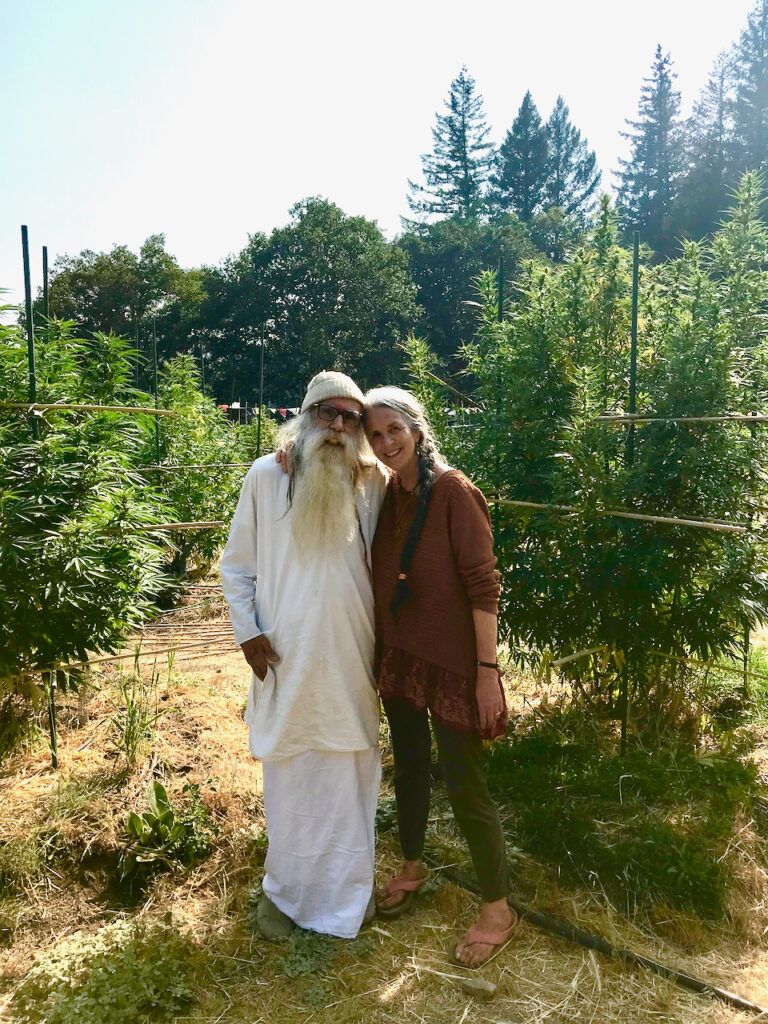
It’s a relief to be themselves again. Swami is helping to educate the next generation of cannabis connoisseurs, as a member of the Ganjier Council and one of the instructors.
“We are not retired,” said Nikki, “but we get to enjoy life, helping other farmers, putting on events. We’re trying to save small farms in Mendocino and figure out ways to help get it right.”
There has been talk in the community about the hope for a future in which farms could sell Direct to Consumer (DTC) but there are many obstacles to getting a bill passed. There is currently a bill waiting on Gov. Newsom’s desk that would allow for sales at state-permitted farmer’s markets. Although this is not the DTC model many hope for, it could be a first step in that direction.
“Not to mention, all the retailers and distributors would be against it. It’s a super uphill battle,” said Swami.
When they first decided to go legal, some very dear friends who were also growers thought it was ridiculous.
“And it turns out, they were right. But we felt we had to. We had to make a statement. Some people may laugh about it now, and say ‘told you so,’ but we don’t regret it. Going legal helped establish us and the brand. We can still bring people together. But I never want to be a fucking CEO again,” said Nikki.
In truth, the couple seems relieved to be done with the business of growing cannabis. Is this the end of another era, or the beginning of something new? Only time will tell.
In life, nothing is constant. Land changes, people change, societies change, and industries change. Nikki and Swami are a constant. Stable in their union and values as the land on which they homestead. Living out here, you learn to rely on yourself and each other, evident in the hillside farm stands that have popped up in these mountain communities to replace the lack of a grocer. Take some eggs and kale, leave some cash and a note.
Built on trust. Like Swami and Nikki, these towns and the people in them are resilient and will find a way.
Subscribe to Fat Nugs Magazine!
Love this article? Show your support for Fat Nugs with a magazine subscription!
As a fully independent media organization, Fat Nugs relies on the grassroots support of individuals like you to continue to write and share these articles. Every subscription helps us keep bringing you the unbiased, broad-ranging cannabis, hemp, and psychedelics articles like these.