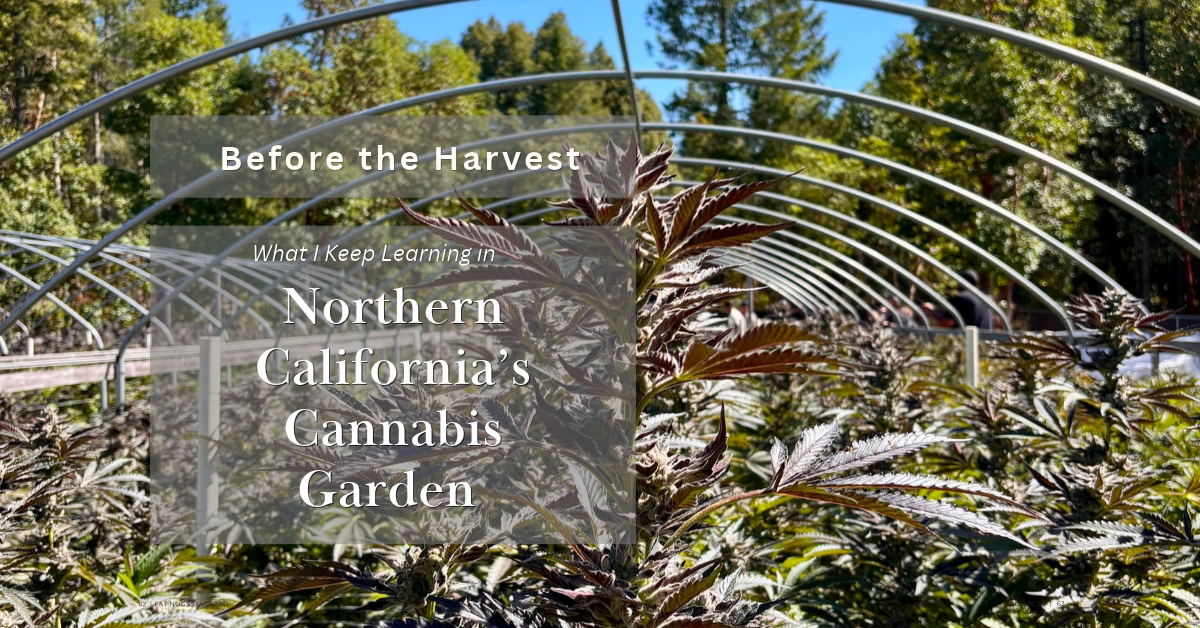
Their lead farmer, Aaron Keefer, came to cannabis with an unusual background that included years working with the culinary gardens connected to The French Laundry and the Thomas Keller Group, and the farm also became an early OCal-certified cannabis operation.
What stayed with me most was simply walking the property with Mike and realizing how much it felt like what it is: a working farm. There are plants, greenhouses, animals, and people doing the daily work of agriculture. Mike told me visitors are sometimes surprised by that. People still arrive with an idea of what a cannabis operation is supposed to look like, and then they discover farming.
Mike made another point that has stayed with me. Large cultivation operations may win on scale and price, but they cannot reproduce a particular farm, its people, or the feeling of actually being there.
Wine Country vs Weed Country in Northern California
That is something I have seen repeatedly in the private farm experiences I arrange: the days themselves are intentionally pretty simple.
People meet the farmer, walk through the garden, ask questions, and have enough time that the conversation can wander. We may sit down for a picnic lunch afterward, and sometimes people add a winery visit or a dispensary later in the day.
What continually surprises me is that guests may arrive thinking the cannabis plants will be the story, but afterward they often talk just as much about the farmer. They remember something Spencer told them, an animal wandering around the property, the mountains, the drive through the country, or a conversation they never expected to have.
My background is hospitality, so perhaps I naturally notice that. Wine Country learned a long time ago that people do not only remember what was in the glass. They remember where they were, who they met, and how the experience made them feel. Cannabis has that same human side, and I think it sometimes gets lost when everything is reduced to packaging, percentages, and what is sitting on a retail shelf.
The Future of Weed Tourism in Northern California
Jamie Peters-Connolly of
Visit Mendocino County gave me another way to look at where cannabis fits.
When we talked about tourism, she did not describe cannabis as something that needed to sit off by itself in a separate category. She talked about it alongside agriculture, food, lodging, wellness, and outdoor experiences. We discussed possibilities including boutique experiences, restaurants, inns, meditation, forest bathing, and stargazing.
I liked that because it feels very Mendocino to me. Nobody goes there for only one reason. You might go for the coast, the redwoods, food, wine, hiking, or simply to get away for a few days. Cannabis can become another layer of that experience and another part of the county’s agricultural story rather than something isolated from everything else.
Leigh Anne Baker of
JANE Dispensary made me think about the other end of that connection. For many travelers, the dispensary may be their first real conversation with someone in Northern California cannabis.
Leigh Anne sees dispensaries as ambassadors for the region, and I think that is exactly right. A knowledgeable person can explain where something was grown, who grew it, and why one farm may be different from another. That becomes much more meaningful after someone has actually been on a farm. A name on a package that meant nothing in the morning may mean something completely different by the afternoon because now there is a face and a place attached to it.
Leigh Anne also pointed out that cannabis is constantly compared with wine even though the two industries still operate under very different rules. Wineries have spent decades developing tasting rooms, clubs, shipping, and hospitality. Cannabis is still discovering what its own version of that relationship can become.