Right now, those same mountains sit at the center of one of the most important cannabis preservation stories in the world. Most people just don’t realize it yet.
Before We Talk About the Ganja, We Need to Talk About the Storm
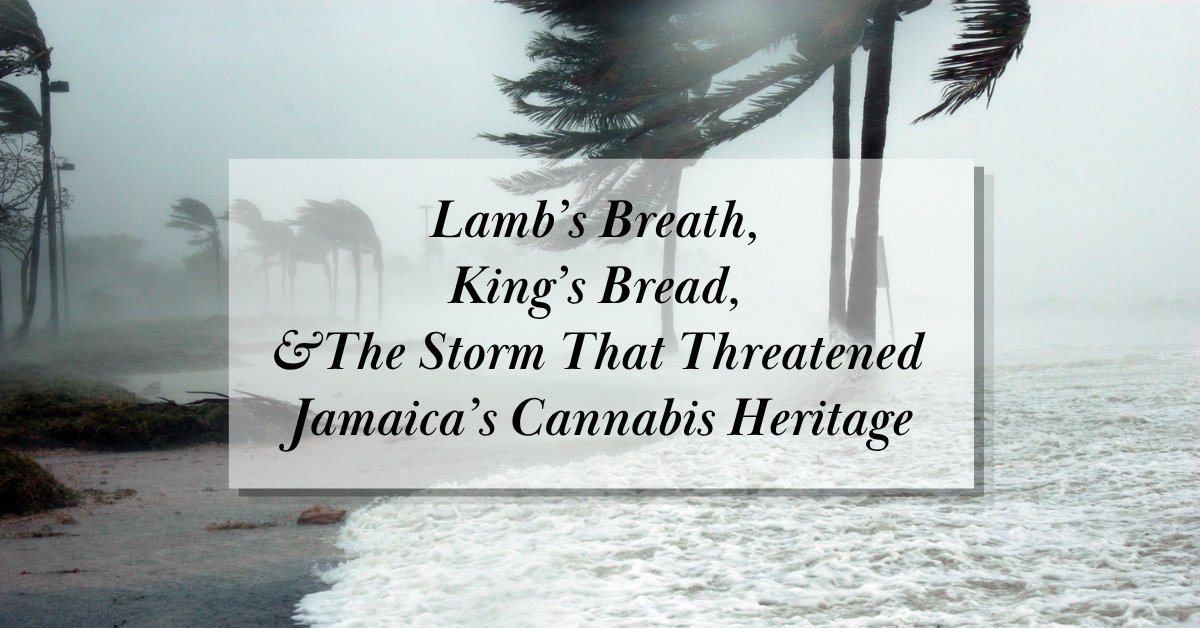
In recent years, Jamaica has taken repeated hits from major storms and hurricanes. These events don’t just damage infrastructure; they reshape entire landscapes. On October 28, 2025, Jamaica took
a direct hit. When a storm like Hurricane Melissa hits the mountains, the damage is different than what you see along the coasts.
Rain falls hard enough to move hillsides. Mudslides carve through farms and small communities. Roads disappear. Entire areas become cut off. For a country the size of Jamaica, an event like this can disrupt lives for years.
When the damage was first counted, early estimates exceeded $8 billion USD. Later economic analysis pushed the number closer to $12 billion in damage and losses. And high in the mountain countryside, far from the resorts and beaches, small farmers lost something else precious: seeds.
Not just any seeds.
If you care about cannabis history, these seeds matter more than almost anything else. Because those mountains still hold some of the last surviving populations of Jamaica’s original cannabis landraces, the plants people around the world know as Lamb’s Bread, sometimes called Lamb’s Breath, and King’s Bread.
Long after the storm headlines fade, farmers are still rebuilding. Homes, fields, greenhouses. Entire livelihoods.
If you want to help, there are still active grassroots recovery efforts supporting rural Jamaican communities, especially farmers working to rebuild agricultural land in places like the Rastafarian Indigenous Center and cities like Westmoreland, St. Elizabeth, and St. James. Support sites like GoFundMe can help. One called
Emergency Relief for Rastarian Indigenous Village was set up by cannabis legend Steve deAngelo.
These are not just farming regions. They are part of the cultural backbone of Jamaican cannabis. And every cannabis story starts with a farmer.
Before There Was Ganja in Jamaica, There Was a Ship
Cannabis isn’t native to Jamaica.
It arrived in the mid-1800s, brought by Indian indentured laborers after the abolition of slavery, when plantation owners were searching for new sources of labor. Those workers brought seeds, knowledge, and a word still used across Jamaica today: Ganja.
Over the next century and a half, something remarkable happened. The plant adapted.
To Jamaica’s equatorial light cycle, its volcanic soils, its rainfall, and its steep terrain. Generation after generation, farmers saved seeds from the best plants and grew them again. No labs. No breeding charts. Just observation, patience, and time.
What emerged from that process is something modern cannabis has almost forgotten how to produce: a true landrace. Plants shaped by place and by the people who care for them.
These are tall plants with long flowering cycles, often 16 weeks or more. Beautiful, narrow leaves reaching for the sun. Airy buds carrying aromas of earth, citrus, spice, and something older than anything you’ll find in a dispensary jar today.
Out of that foundation came two names that traveled far beyond Jamaica: Lamb’s Bread and King’s Bread.
Jamaica’s Cannabis Heritage
Lamb’s Bread
Ask 10 growers what Lamb’s Bread is, and you’ll get 10 different answers. That’s what happens when a plant becomes legendary before anyone properly documents it.
What most agree on is this: Lamb’s Bread was a Jamaican landrace sativa known for effects the modern market rarely delivers anymore: clear, cerebral, and uplifting.
This wasn’t couch-lock cannabis. This was ganja people smoked before music, before creativity, before long conversations that stretched deep into the night.
Plants could grow 10 to 12 feet outdoors. Flowering could take 12 to 16 weeks, sometimes longer.
Within Rastafari culture, ganja has long been treated as a sacrament used in reasoning sessions to quiet the noise of the world and speak truthfully with one another. Not for escape. For clarity. To many, it is still understood as a gift from Jah.
The Spiritual Roots of Cannabis in Rastafari
Rastafari spirituality draws deeply from Ethiopian symbolism and the legacy of Emperor Haile Selassie I, often associated with the Lion of Judah.
Within that worldview, names like Lamb’s Bread carry meaning beyond agriculture. They reflect ideas of nourishment, humility, and divine provision. For many Rastafari, the herb has never simply been a plant. It is part of a relationship between people, land, and Jah.
King’s Bread: The Elder in the Hills
King’s Bread rarely shows up in modern cannabis conversations. But among growers familiar with Jamaican landraces, it’s often described as an older Blue Mountain population, possibly part of the genetic foundation from which Lamb’s Bread was selected.
Unlike Lamb’s Bread, it never became a global name.
King’s Bread stayed in the hills of Jamaica.
In places like Westmoreland, St. Elizabeth, and remote Blue Mountain communities, where seeds were never commodities, they were inheritance. Passed down. Shared. Protected. That obscurity may have helped preserve it.
Until Hurricane Melissa.