What if we made a concentrate without throwing away all the plant has to offer?
For as long as there have been humans growing cannabis, there have been humans engaged in the noble pursuit of making it stronger. Genetics and breeding can take you a long way; the average THC you will see on shelves of your favorite dispensary towers over what was available in the ’90s, but biology alone can only take you so far.
In the pursuit of ever-climbing potency, humans began turning to methods of concentration as an avenue for pushing more into less. The trade-off is that most of those methods get their strength by throwing away nearly everything else the plant makes.
Rick Simpson Oil (RSO) takes the opposite approach, and it makes a strong argument that what gets thrown away matters more than we think.
The Complexity of Cannabis and Concentrates
Most cannabis concentrates work on a principle of refinement. You use things like heat, solvents, and vacuum pressure to precisely extract cannabinoids like THC based on their differing chemical properties. What you end up with is oil that can contain up to 90% THC or CBD content. Isolates take this even further, reducing it all the way down to a powder that can test up to 99% pure by weight. Is anything important lost in this process?
Natural cannabis flower contains thousands of different chemical compounds. You have around 100 known cannabinoids[1], 200 or so terpenes[2], and more flavonoids, phenols, and fatty acids than we can count.
The tragedy of concentration is that part of the refining process means, by definition, losing almost all of that in the hunt for potency. In the end, you have a product that is orders of magnitude “stronger” than natural flower, but it also lacks nearly all of its original character. THC is the chemical most famous for cannabis’ psychoactive effects, but it is, in truth, only one member of the symphony. A damn fine first chair violinist, but far from a full philharmonic.
In philosophy, we would call this the “Gestalt”; the idea that sometimes a collection of things becomes something more than simply the sum of its parts. In cannabis, researchers have a specific name for this: “the entourage effect”. Here, it refers to the fact that the effects you feel when smoking or otherwise consuming cannabis are actually the result of hundreds of different interactions between all of the different chemical compounds in the plant.
In concert, they produce effects that no one of them produces on their own. CBD, for instance, seems to lessen the psychoactive intensity of THC, while terpenes such as myrcene and linalool regulate the interaction of cannabinoids with the endocannabinoid system in your brain at the receptor level, changing the way you feel along the way. This is actually what makes one strain feel different from another.
Different strains, as a result of their differing genetics, produce different ensembles of these chemicals, and when consumed, the way they come together changes, and in turn the effects you experience change as well.
The Difference of Full-Spectrum RSO
It is in recognition of this wasted potential that RSO endures. RSO is what we would call a “full spectrum extract” because it preserves the full spectrum of chemical compounds found in flower.
It’s the answer to the question: “What if we make a concentrate without throwing away all the plant has to offer?”
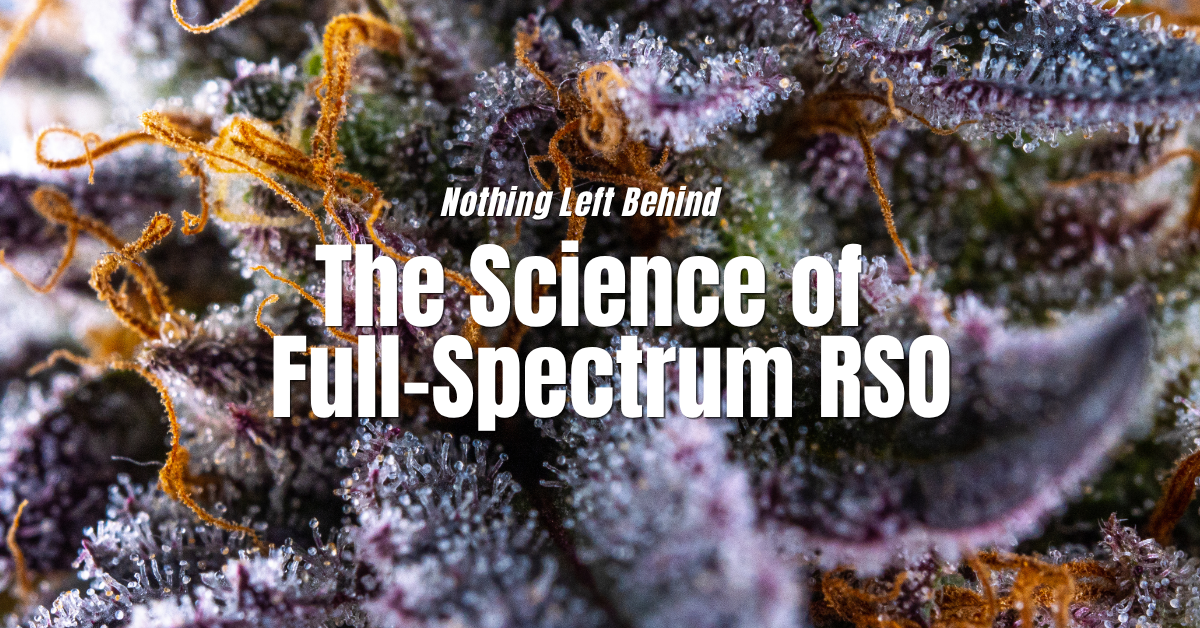
A basic solvent like high-proof alcohol is used to extract the symphony of sorts, then it is slowly evaporated off, leaving behind a thick, richly colored oil, with all the original members of the band turned up to 11. RSO neither looks nor tastes like anything else you will find on the shelves, and it hits with the same complexity and nuance as real flower. More than that, like flower, it offers many of the same medical benefits, which is fitting given its history.
Where Did RSO Come From?
The origins of RSO are nearly the subject of mythology at this point, despite being a comparatively recent addition to the long history of cannabis products.
In 2003, a Canadian engineer for whom the oil is named found himself with a diagnosis of basal cell carcinoma (a common type of skin cancer).[3][4] Feeling his available medical options weren’t up to muster, he was allegedly inspired by a study he had read about the effects of cannabis oil on cancer in mice. After some tinkering at home, he came up with what is today known as RSO. He applied some to his lesions, and (according to him) the lesions were gone in a matter of days.
Following this, Rick sought not to profit from his invention, but to sing its praises as far and wide as he could and share his methods for free with anyone who would listen. Over time, it made him a bit of a household name in the cannabis community, and he is regarded as one of the plant’s most notable activists in recent years. His initial claims of it curing his cancer should be viewed skeptically. To date, there is no compelling evidence that RSO has uniquely cancer-fighting qualities, but that doesn’t mean it hasn’t proved an incredibly valuable tool for many in need of some natural medicine.