Transpiration in Cannabis Cultivation
At a basic level, you can think of transpiration as the plant’s perspiration. Water evaporates mostly from the underside of the leaves, cooling the plant a few degrees, just as evaporating sweat cools our bodies when we are overheated.
But transpiration is much more complex in its function and purpose.
It starts in the substrate. As the plant grows, its roots permeate the substrate as much as possible in the search for water and nutrients. When that water is present, it becomes about the equalization of osmotic pressure between the roots and the substrate. The roots are a semipermeable membrane that will allow water (along with nutrients) to pass through it. This will continue to happen until the pressure is equalized between the roots and the substrate.
That’s just the beginning. Above the surface, light is being absorbed by leaves. This energy is used primarily to power the synthesis of simple sugars. Water from the substrate and carbon dioxide from the atmosphere are reordered to create those sugars.
The byproducts of that process are oxygen and water vapor. That water vapor is released through microscopic “valves” on the underside of the leaves called stomata, where it evaporates into the atmosphere. This has two primary effects. First, just like drying sweat, this process cools the surface of the leaf. As that water evaporates, it creates a vacuum. This pulls more water from the root system through the plant’s xylem, part of its circulatory system.
During daylight hours, this process will be continuous as long as there is a greater osmotic pressure of water in the substrate. When the substrate gets too dry, that pressure equalization halts. The plant begins to wilt to limit light exposure and close the stomata to help prevent further water loss. When this happens, photosynthesis and evaporative cooling come to a standstill. If poor conditions continue, that stress will lead to nutrient deficiencies and tissue damage.
In order for these processes to run optimally (to keep that vacuum of water and nutrients flowing), there also has to be somewhere for the water vapor to go. It evaporates into the air surrounding the open stomata.
But what if that water has nowhere to go? What if the atmospheric air is so humid that the water cannot evaporate quickly enough or even at all?
The easiest way to relate is to think, again, of sweating. If one sweats in a desert that is 90 degrees, the sweat evaporates much more rapidly, allowing the body to cool itself. But in a jungle environment, the humidity is higher, and the sweat evaporates more slowly, if at all.
This is because of vapor pressure deficit, or VPD.
Vapor Pressure Deficit in Cannabis Cultivation
Most of us are familiar with the term relative humidity, or RH. It is a representation of the amount of moisture in the air, expressed as a percentage. But it’s relative. The higher the atmospheric temperature, the more moisture that air is able to hold. As the temperature increases, that percentage goes down, and the air is able to accept more moisture. Evaporation also happens faster at higher temperatures.
Conversely, as the temperature goes down, that RH percentage rises. The air becomes more “humid” and evaporation slows. If the temperature drops to a point where the RH is 100%, or the air is unable to hold any more moisture, that moisture starts to collect as condensate, like the dew on the grass. That threshold is called the dew point.
This is where vapor pressure deficit becomes the more relevant metric than relative humidity. You can think of VPD as the atmosphere’s resistance to accepting moisture from the plant. If there is a high VPD, air is capable of transferring moisture rapidly from the plant. If the VPD is too low, this evaporation happens much more slowly, if at all.
Remember that the water is also carrying with it all of the elements that the plant needs to perform and grow – nitrogen, phosphorus, potassium, etc. If the water is flowing too slowly or too quickly, deficiencies or toxicities can start to occur in plant tissue, even though there may be the right amount of nutrients available in the substrate. If your heart was pumping your blood too slowly or too quickly, you’re gonna have problems.
VPD is the difference between how much water vapor the air currently holds and what it’s capable of holding. It is typically measured in kilopascals (kPa) or 1000 pascals, the metric unit of measurement for pressure, air or water.
How exactly that calculation is made is unimportant for the purposes of this column, and I’d honestly have to brush up on my physics before I wrote a word.
Understand that this number is very important to plants, especially those in a controlled, high-performance environment, like an indoor cannabis garden. It’s also important to understand that cannabis likes different VPDs, depending on its current stage of life. The earlier in its life cycle, cannabis likes the lower VPD.
Early in its life, whether it be a seedling or a clone, the plant likes lower transpiration rates. The root system is still developing, so water may be in short supply. If the VPD is lower, there is less demand on that new root system to deliver water to the biomass at the top. As the plant continues to grow, developing more and larger leaves capable of photosynthesis, the higher the VPD the plant will tolerate and even demand. The demand for water and nutrients grows exponentially, and the blood has to flow faster, so that evaporation at the leaf stomata has to happen faster.
A General Rule for Vapor Pressure Deficit in Cannabis.
- Clones and Seedlings = VPD of 0.4 – 0.8 kPa
- Vegetative Plants/Early Flower = VPD of 0.8 – 1.2 kPa
- Mid to Late Flower = VPD of 1.2 – 1.6 kPa
Understand that these are just guidelines. Plant genetics, light intensity, and room temperature; any number of variables can determine what is appropriate for fine-tuning.
When I am cloning, I typically aim for an ambient temperature of 75°F and a relative humidity of about 75%. This equals a VPD of 0.74 kPa. By the end of flowering, my VPD could be as high as 1.8 kPa, especially if I am intentionally drought-stressing a crop – but that’s a subject for another column.
Calculating Vapor Pressure Deficit in the Grow Room
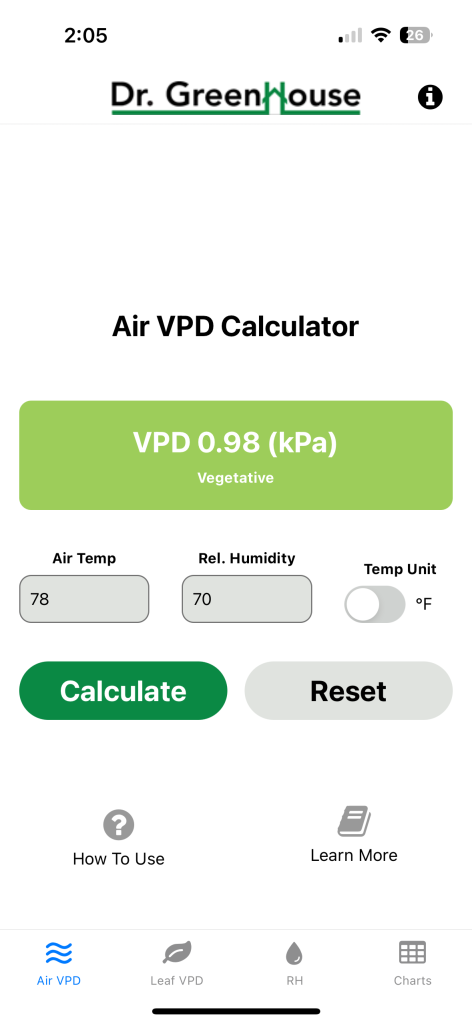
So, how the heck does one calculate VPD, anyway?! Well, fortunately, you don’t have to do the math. There are plenty of charts and calculators online. With a quick search of the App Store, I found a very simple one for free from Dr. Greenhouse, AKA Nadia Sabeh, an industry expert in horticultural environmental control.
All that you need to calculate the ambient VPD is a simple room thermometer-hygrometer combo. If you don’t already own one (or a few), it should be the first meter that you purchase. They start around $10. I prefer the old analog style. They can be more accurate than cheap electronics.
If you want to get really fancy, also pick up an IR thermometer from the hardware store. Probably another $25. Remember from above that transpiration cools the leaf surface? Well, the IR gun will measure actual leaf surface temperature, which you can use for your temperature input. A good rule of thumb is to subtract two degrees from the ambient room temperature.
Controlling vapor pressure deficit is also an excellent way to dry and cure your flower, but we’ll get into that in a later column. Until then…