

The cannabis industry is facing an unprecedented energy crisis. U.S. electricity costs rose 5.9% over the 12 months ending May 31, 2026, with cultivation and processing operations bearing the brunt of these increases. Indoor cannabis grows consume approximately 50 times more power per square foot than a standard office building, and with margins already under pressure from intense competition and price compression, operators simply cannot pass these rising costs onto consumers.
For cannabis processors using freeze dryers, essential equipment for producing premium extracts, live resin, and solventless products, energy consumption has become a critical operational metric.
The Energy Crisis in Cannabis Processing
Industry operators across the cannabis supply chain are feeling the financial strain. Reports indicate electricity cost increases of 8-12% over the past 16 months, with some facilities seeing even steeper jumps. A senior operations executive recently noted that energy prices have increased an average of 7% per year over the last 50 years, making electricity one of the largest and least controllable input costs for cannabis businesses.
For freeze drying operations, the energy drain comes from multiple sources: refrigeration systems that must maintain temperatures below -45°C, vacuum pumps that run continuously, and shelf heaters that carefully apply heat during the sublimation process. Industry analysts report that HVAC, ventilation, and dehumidification account for about half of all consumption in cultivation facilities, and freeze dryers are major contributors to this load.
In one example, a 300,000-square-foot facility runs a monthly power bill of approximately $400,000—a figure the operator describes as “efficient” given the scale. For smaller processors, every kilowatt-hour saved directly improves the bottom line.
The Xiros Mikro Advantage
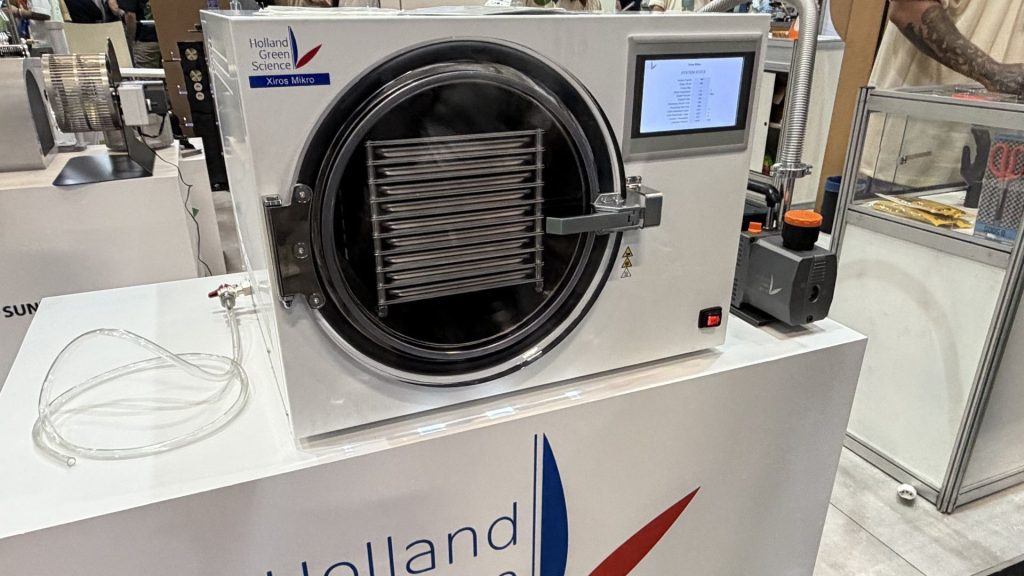
With an average power consumption of just 700 watts, the Xiros Mikro is designed to deliver professional-grade freeze-drying performance with remarkably low energy draw. To put this in perspective, consider that some comparable freeze dryers on the market are reported to draw significantly more power, in some cases, upwards of 1,400 watts or more depending on configuration and operating conditions.
For cannabis processors running multiple freeze dryers around the clock, even modest per-unit savings compound quickly. Consider a modest operation running four freeze dryers simultaneously:
- Xiros Mikro units (4 × 700W): 2,800 watts continuous draw
- Typical comparable units: 5,600+ watts continuous draw
- Potential energy savings: 2,800+ watts, equivalent to removing a significant portion of the processing facility’s electrical load
Over the course of a year, with electricity rates averaging 12.7 cents per kilowatt-hour in lower-cost markets (and upwards of 45 cents in higher-cost regions), the savings are substantial. At 12.7¢/kWh, running one Xiros Mikro continuously for a year costs approximately $781 in electricity. A comparable unit drawing 1,400W would cost roughly $1,560 annually, a difference of nearly $780 per unit per year. In high-cost markets where rates reach 45¢/kWh, that annual savings per unit could exceed $2,700.
Engineering Efficiency Without Sacrificing Performance
The Xiros Mikro freeze dryer achieves this remarkable efficiency without compromising the rigorous demands of cannabis processing. With technical specifications that rival any competitor—including an ice condenser capacity of 8 kg, condenser performance of 4 kg per 24 hours, ultimate vacuum of 1.5 × 10⁻¹ mbar, and minimum shelf temperatures of -40°C—the Xiros Mikro delivers professional-grade results.
The Bottom Line: Energy Engineering as a Competitive Advantage
As one industry executive recently put it, the operators who succeed in the coming decade will be those who engineer their operations around energy costs. Treating energy as a central cost like labor is essential to staying competitive in an increasingly challenging market.
The Xiros Mikro freeze dryer embodies this philosophy. By delivering professional freeze drying performance with significantly lower power draw than many comparable units, it gives cannabis processors a tangible path to margin protection in an increasingly difficult market.