Nothing in this article should be taken as medical advice or a scientific claim. This article contains anecdotal observations and is based on real conversations I have personally had with real women.
What happens when a stoner has kids? What happens when a suburban PTA mom picks up her first joint and experiences stress relief that no glass of wine has ever brought her?
These are the questions I set out to explore in my conversations with mothers about cannabis. A quick internet search for “cannabis and motherhood” shows no end to the resources for “drug addicted moms.” But as a cannabis writer, consumer, and aficionado, I know the conversation is more nuanced than Google (or our government) wants it to be.
At the heart of my interest is this simple question: how has the propaganda of the war on drugs swayed how we see cannabis consumption in mothers? What does consumption actually do for Mom?
Cannabis & Motherhood: Reclaiming the Conversation
I set out to have this conversation with as many mothers as I could, to reclaim the narrative that moms who smoke weed are bad moms. Fortunately, I have a large network of friends in the industry who are also cannabis mothers and are generously willing to share their time, energy, and motherhood insights with me.
So far, I’ve talked with eight mothers: Kenya Alexander, LaWann Stribling, KC Santana, Bri Smith, Chrissy Harrell, Tanya Griffin, Megan Mbengue, and Bri Ash.
All of these women work in the cannabis industry and have children. But that is where many of the similarities end. These women live in different states, with different professions, and different numbers of kids at all ages. They come from different backgrounds and family structures, and cannabis entered their lives at different times.
What surprised me is how many common themes emerged in these conversations. Themes like patience, plant medicine, and dropping into a stronger sense of self. Over and over in these conversations, these women told me how cannabis makes them better mothers; more patient, more present, and more willing to play.
When it’s put like that, who could deny that cannabis aids motherhood?
7 Lessons I Learned from 8 Conversations Around Cannabis & Motherhood
1. Patience is a (Cannabis) Virtue
Patience is one of the most important virtues of parents, especially when kids are young. It’s also one of the most taxed resources for any adult in the world today, particularly Americans. We wake to screaming alarms, drive through rush-hour traffic, endure meetings that could have been emails, and face record-high prices at the gas station. Little wonder that patience is in short supply.
But kids don’t care about any of this. They just want Mom to play. And when it’s 7 pm at the end of a long Wednesday, that simple ask can feel impossible. But cannabis can change that.
“Cannabis improves my quality of life.” Chrissy Harrell, mother of two in Louisiana, told me. “Cannabis makes me a better mom. A more chill mom. It takes the edge off, so I’m calmer and more engaged.”
Chrissy & her daughterTanya Griffin, a mom of six based in Colorado, echoed this. “I’ve built companies all my life. When that call comes, my instinct is always to pick up the call and handle it. But cannabis allowed me to focus at a certain point in the evening. I could be in the moment, helping with science homework.”
That patience needed to drop in the moment and meet kids where they are is a virtue of what cannabis can do.
“Weed helps me maintain patience – the patience it takes to remember that my kids are little human beings learning the world, and how I treat them now is how they’ll interact with the world later.” Kenya Alexander, mom of three, told me.
If relaxation is the opposite of stress, overload is the opposite of patience.
“Cannabis has helped my motherhood journey. It helps me be more relaxed and deal with the stresses that come with being a mother of many. It helps me sleep better.” LaWann Stribling, mother of six in Maryland, said.
“The plant softened my edges.” Megan Mbengue, mother of two in California, told me. “I became more present and less strict with my boys.”
2. Cannabis Helps Moms Emotionally Regulate
Emotional regulation is a big part of patience as well, which cannabis can also help with. I quickly noticed this theme threading through my conversations, even without specific prompting. It seems cannabis helps parents, already swamped with tasks and responsibilities, and then parenting in a rapidly declining late-stage capitalist country, regulate their emotions.
“Cannabis centers me and helps me regulate my emotions better.” Bri Smith, a single mom of one, told me. “When I’m maxed out on sensory overload and totally dysregulated, I lose my capability to communicate calmly. Cannabis helps me be present and give all of my attention to my daughter, instead of worrying about a million things like dinner, dishes, and bedtime.”
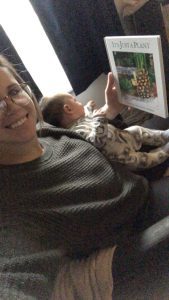
Bri Smith and daughter reading It’s Just a Plant
Tanya agreed. “One of the hardest parts of parenting is paying attention to your kids without distractions.” She said. “When you’re filled with fear and anxiety, you show up as a parent like that. Kids respond to that.”
Kenya also touched on this. “Being a parent is so much sensory overload at all times. Kids challenge you to slow down and be present and patient. Cannabis helps me shed that need to perform motherhood, and it calms the part of my brain that always wants to go, go, go.”
Cannabis makes it easier to ignore the dirty dishes piling in the sink, the unread emails you have to respond to, and the headlines screaming about how much the world is literally burning down.
Bri Ash, a mother of one, agreed too. “Cannabis helps keep me mellow and helps my son navigate his big emotions. He feeds off my emotions, so I can’t let the overwhelm get to me in the moment.”
“Something I’ve noticed as a single parent is how much [my daughter] feeds off my energy.” Bri Smith said. “I’m distracted all the time–it’s hard to juggle giving her enough attention with staying on schedule and cooking dinner, and getting her to bed. The more frantic I get, the more she vies for my attention by jumping, pulling, and pushing. I’ve realized that when she starts pulling for my attention like that, it’s a cue for me to consume, re-regulate, and be present in the moment together.”
Chrissy said, “I can shut the ‘work’ section of my brain off and really be present with them. It makes quality time with Mom better. I’m 100% more patient, more thoughtful, and less irritated.”
3. Cannabis Becomes a Medical Cabinet Staple
For many moms, cannabis has quickly integrated itself into the medicine cabinet.
“The taboo around children and cannabis is unfair, especially considering some of the medications they’re prescribed as they grow up.” Bri Smith said. “We need to have more realistic conversations around phyto-cannabinoids and our kids. Giving your kids CBD should not be a crazy thing!”
Megan agrees. “CBD in my house is like Windex in My Big Fat Greek Wedding. My kids use topicals for rashes, CBD for headaches and body pain, and CBG to manage anxiety.”
“I have this CBG vapor rub I’ve used when he’s sick.” Bri Ash told me. “He’s tried these low-dose CBD lollipops. I’m interested in how to make the plant part of his daily supplement.”
And for many, cannabis is just one herb of many that is used.
“When my daughter had hand, foot, and mouth disease, we used plant medicines from the start.” Bri Smith said. “She was on a regimen that included lemon balm, lavender, valerian root, CBD, and other medicinal herbs. Other kids [in her preschool] had 50+ blisters all over their bodies; she only had a few on her hands and feet. Plant medicine made all the difference.”
“Herbs go in everything! I use mullien, especially when I’m smoking. I love lavender and chamomile, ginkgo, hibiscus, and lemon balm.” LaWann told me. “I’ve given my kids CBD honey.”
LaWann and her family
“It’s a plant, it’s medicine, and it was put here for humans to use intentionally. It’s one of many plants that can help us with ailments and conditions.” Chrissy said.
4. Cannabis Gives Moms (Mental) Space
Another big theme I heard was how much cannabis helps moms make space for themselves
KC Santana uses the plant to help her show up in the gym. After she gave birth to her first child, she recognized signs of PPD. “I had to work not to fall down the rabbit hole of post-partum depression. Cannabis was a supplement that helped me recover.”
As she’s had more kids, cannabis has helped KC retain her sanity. “Having a 7-year-old, a 5-year-old, and a baby makes the days totally crazy. I had a C-section with my last baby, and the recovery was completely different. If I didn’t have cannabis…” KC trailed off, eyes wide.
For some moms, the opposite is true and needed.
“One of the most profound changes that I remember from then [when cannabis became a part of my life] is around my workouts,” Megan said. “I was working out six days a week, highly regimented, no matter what else was going on. When I started consuming cannabis and listening to my body, I realized that I don’t have to do it if it doesn’t feel good. Cannabis opened up a world of being able to connect with my body for the first time in my life. I teach my kids how to listen to their body… I share tools with them, like meditation and body scans. These were things I had never done before cannabis. But now, I can teach them how to listen to their intuition.”
Cannabis can make space, mentally, from big emotions. Motherhood can be wholly consuming, but cannabis can help with that, too.
“It’s very easy for women to get lost in the throes of motherhood and throw everything they have into that,” Megan said. “There was a shift [for me] when I started consuming cannabis that I could do things for myself without guilt.”
Kenya agrees. “I love being a mom, but it was a tough adjustment for a time. Now it’s my favorite thing to do, but it takes so much out of you. Cannabis has given me space to lean into who I am, and the space to be myself.”
That mental space lends itself to entering a calmer headspace for kids, no matter what the day has held. Over time, this space created helps moms. It is perhaps too intangible to say it helps them remember who they are, but this was the sentiment echoed in multiple conversations.
“It’s made the entire experience more enjoyable because it gives me space,” Kenya told me. “For so long, I felt like I was going through the motions of motherhood without feeling connected to the action. Society views motherhood as all-consuming. Cannabis gives me the space to find myself again in this journey.”
Bri Smith agrees. “Parenting is so tied to your mental health. Cannabis has changed my life in many ways, especially as a parent. I proudly stand behind it.”
KC and her son at the ocean
5. Cannabis Helps with Pain Management
For Moms who struggle with chronic pain or ailments, cannabis presents viable management alternatives to stronger pharmaceuticals.
Bri Smith knows this well. As someone who suffers from chronic pain, cannabis helps her.
“It’s helped me with everything from digestive issues to joint and muscle pain. I tell [my daughter] about the pain in my joints and how it means I can’t pick her up, or the pain in my head and how it makes me not want to play. Cannabis has helped me manage pain in a way that other medicines can’t. Pharmaceuticals take away the pain, but they take away other things too. Cannabis takes away my pain without taking me from the moment.”
These alternative modalities offer physical relief options without the potential of “getting high” or passing cannabinoids along in the bloodstream or breast milk. And as any mother will tell you, it’s not not painful.
“Pregnancy and the post-partum period opened my eyes to other forms of the plant. Tinctures expanded my knowledge and topicals after my son was born – especially patches – to help with the pain.” Bri Ash said.
6. The Conversation Around Cannabis and Pregnancy is Touchy
The tricky parts of the conversation continue to evolve. Some moms rely on the plant even during pregnancy, while others eschew it entirely.
“There wasn’t, at the time [when I was pregnant], a lot of information around pregnancy and cannabis consumption. It gave me a caution around consuming.” Bri Smith said. She switched from smoking to tinctures with the occasional toke of a dry herb vaporizer.
KC also consumed during pregnancy. “I consumed while pregnant with my first two. For my first, I stopped at 30 weeks. For my second, I consumed all the way to labor and delivery.”
Fears around CPS also played a factor. “I stopped at 12 weeks. I was so worried about CPS in traditional hospitals. I don’t think there’s anything wrong with consuming while pregnant, but I stopped just to avoid the anxiety of CPS.”
Others shy away entirely. “I didn’t consume while pregnant or breastfeeding, but as soon as I stopped nursing, I started smoking again,” LaWann said.
But for some, hyperemsis gravadarium, a devastating form of ceaseless nausea, necessitates cannabis or pills. “I stopped smoking the day I found out I was pregnant. But I hit week 7, and I couldn’t keep anything down – food or water.” Bri Ash said. “I was diagnosed with hyperemisis gravidarium. I started asking around to friends, and a few said cannabis helped. I took one small toke out of a glass bowl, and it changed everything.”
Alone in a prohibition state and incredibly ill, Bri relied on cannabis to continue to be able nourish her growing baby. “Cannabis saved the day. Without it, I wonder if I would have survived. Cannabis is what got my baby here.”
The science around how cannabis affects pregnancy is scarce and unlikely to be expanded any time soon. This makes most of the information available coming from anecdotal evidence, with a multitude of factors. The biggest study cited is the famous study out of Jamaica from the 1990s that tracked 24 women who consumed while pregnant and 20 women who did not.
“I relied on microdoses for specific symptom relief. Not once was I ever worried about transference.” Bri Smith shared. “I’d like to add, my daughter is amazing. She was ahead on all of her development milestones, formed sentences before other kids her age, and is bilingual now!”
KC agrees. “I never used cannabis to get ‘so fuckin’ ripped’. Really, the plant helped keep me away from alcohol. I started seeing my consumption as medicinal. It’s always been intentional.
7. Educate Yourself
When I asked each woman at the end of her interview if she had advice for parents looking into cannabis, they all said the same: research. Educate yourself. Find people who know what they’re talking about, and ask questions.”
“If people would just see cannabis as a supplement, not with the stigma, it would change things,” KC said. “ A lot of people who aren’t in the cannabis space just go by the propaganda they learned. It’s better to be curious about these things.”
Tanya agrees, “When I understood the plant and how to dose it with intention, it was life-changing.”
One of the most beautiful and frustrating parts about cannabis is its personalization. Your endocannabinoid system is as unique as your fingerprint, and what kinds of cannabis work for people varies greatly. But the necessary trial-and-error system has a beautiful lesson tucked into it: getting to know yourself.
“Cannabis is not a panacea,” Megan said. It is a tool.
A personalized tool that often takes a little time to learn how to use best. If you’re willing to commit to learning about the plant and yourself, what’s on the other side of that is often a deeper, more meaningful relationship to oneself, one’s role as a mother, and one’s relationship to one’s kids.
And isn’t that something to celebrate deeply?
Exploring Cannabis as a Tool for Motherhood
Time and time again in these conversations, the same threads emerged; cannabis gives mothers the space they need to reclaim themselves and show up as their most positive, patient selves for their kids.
“As a parent, our job is to educate our children, not to keep them in the dark. The greatest dangers come from shielding kids, instead of arming them with the truth.” Tanya said.
In a world where raising kids is seen as both obligatory and wholly sacrificial for women, cannabis offers the respite and space to take a breath.
“It’s about finding balance. You can overindulge in anything – even water. It needs to be a value-add to my life.” Chrissy said.
“Everyone in my life is better for my consuming cannabis,” Kenya told me. “Especially my kids, because I spend so much time with them. I’m so grateful for the plant, the cannabis industry, and this community because it’s truly given me the space to show up as me.”
“These substances can be life-changing,” Megan said. “They can be, and are, abused. But when you have mindfulness and intention, they can change your life. More is not always better – lower doses can have life-changing effects.”
The Science Behind Cannabis & Motherhood
The support that cannabis offers our nervous and regulatory systems is not theoretical. Let me throw some facts at you.
Cannabis is a known tool for vagus nerve regulation, the longest component of the autonomic nervous system, and a key player in your parasympathetic nervous system. This system has taken over headlines recently as stressed-out, underpaid people desperately try to find ways to feel better.
The endocannabinoid system is a master regulatory network whose main purpose is to keep our bodies in a state of homeostasis, or balance. Many chronic ailments or illnesses are found to have a side effect of reduced endocannabinoid production.
Supplementing the system with phyto-cannabinoids from the cannabis plant is found to close this gap and promote balance in previously unbalanced symptoms.
Humans evolved alongside the cannabis plant for at least the past 10,000 years. We relied on this plant for fibres for making clothes, boat sails, and rope. We inhaled the smoke ritualistically. And we ate the plant. The seeds and leaves of hemp and cannabis plants contain minute levels of cannabinoids.
It’s not a massive leap to wonder if we’re all a little cannabinoid deficient, from the past 100+ years of complete prohibition. If no one drank water for 100 years, its effects would be considered medicinal and miraculous, too, instead of just a daily need.
Taking Back the Conversation Around Cannabis & Motherhood
The conversation around cannabis and motherhood is in need of a massive rewrite. For too long, moms have been shamed for turning to a female plant in their most feminine time of need. I do not think that is a coincidence.
These woman each have had their own journeys with cannabis and with motherhood. But what is apparent is that with intention, honesty, and a healthy respect for one’s own needs, there is a balance to be struck between benefiting from cannabis and becoming the best version of oneself as a mother.
A quick toke in the garbage before dinner makes it easy to get on the floor and make believe. An edible makes bathtime a game and not a power struggle. A cannabis beverage makes relaxation achievable with sedation. There is nothing shameful about any of that.
America is a booze country. This is a truth and a commentary on our culture. I envision a world where America is a weed country. This means many things, for our communities and self-sustainability, but most importantly, it means this: a world in which everyone is able to get the support they need, when they need it. A world where the waves of emotions are embraced, not suppressed.
If you think that sounds like a world of higher consciousness, you’re right.
The Stoned Ape Theory posits that humans leveled up in brain processing power and consciousness through the consumption of psychedelic plants.
Who knows? Maybe the next revolution in consciousness comes from pot-smoking moms. I could see it.






 “These substances can be life-changing,” Megan said. “They can be, and are, abused. But when you have mindfulness and intention, they can change your life. More is not always better – lower doses can have life-changing effects.”