
In an industry built on human touch and plant stewardship, automation is often misunderstood, yet when applied intentionally, it can protect quality, stabilize margins, and allow teams to focus on the work that actually matters.
We cannot be certain of much in cannabis, but innovation and change are constant. The industry has evolved rapidly and sometimes randomly for better or worse. We’ve seen operations go from running on whiteboards and clipboards to using seed-to-sale software. Business decisions have become data-driven, processes have been refined, and teams are running lean. Where possible, every step has been taken to increase efficiency. The next step for operators, the industry, and society overall is automation.
How Automation Fits into the Cannabis Industry
Automation can be the answer to scale, the solution to diminishing profit margins, a labor multiplier, and a competitive edge when implemented thoughtfully. Before going down the rabbit hole of automation and the future, it is important to address the by-hand, craft, and artisanal processes and businesses out there. There’s a time and a place for automation. It is not meant to interrupt or reduce the quality of hand-grown, hand-processed products. As things scale in demand, pressure, and competition, automation can be there to help without overtaking the entire process. For emphasis once more, automation isn’t replacing quality or culture but, as we’ll see, enabling it.
For true scale in today’s industry, automation is not an option. It is something every operation should consider, but it does not have to be a complete overhaul. The Fat Nugs team had opportunities this year to learn about several different systems providing automated post-harvest processing and manufacturing solutions. We learned operators can start simple and solve their biggest pain points first, and talked with licensees who have saved real time and money through automation efforts.
Automation to Overcome Post-Harvest Bottlenecks
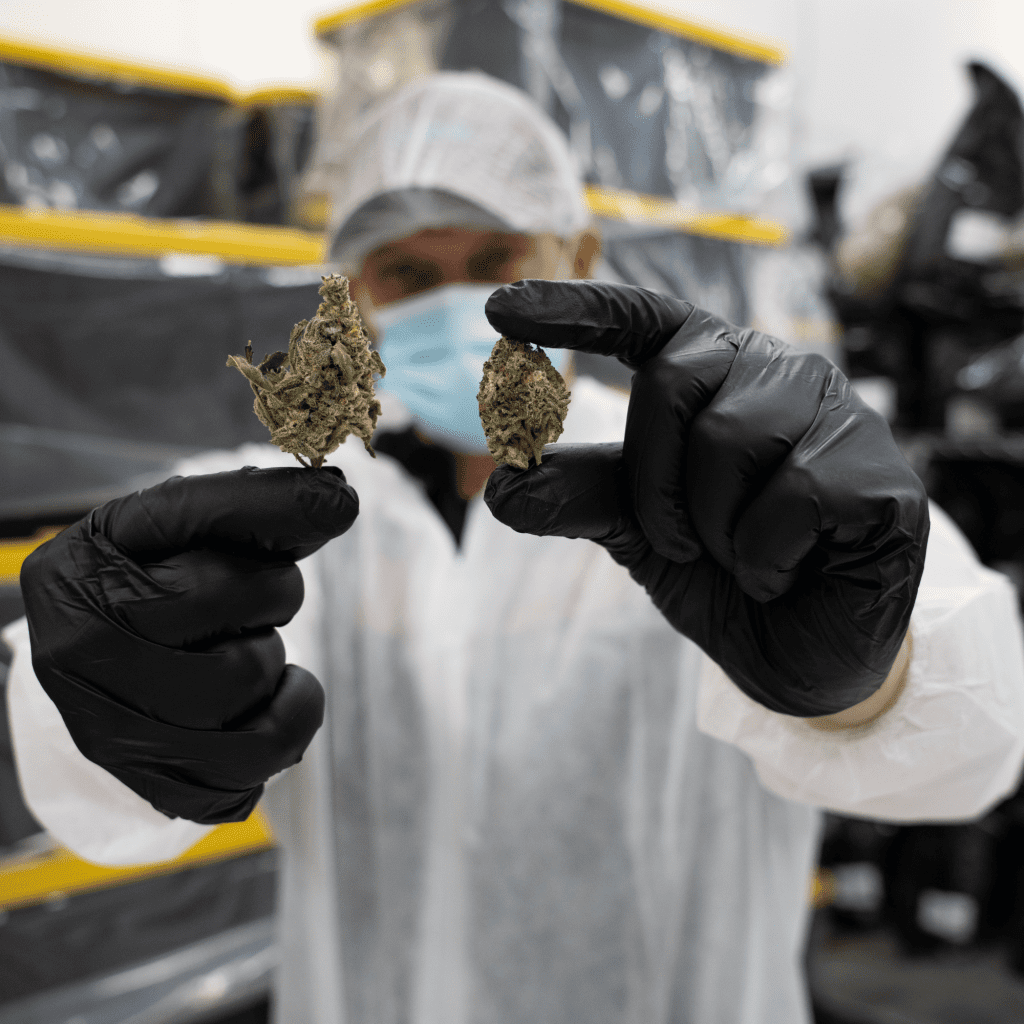
There are automation innovations being introduced at every step of the seed-to-sale supply chain. Too many to discuss in one piece, so we are going to focus on post-harvest processing, which includes everything that happens after harvesting and before selling products to a dispensary or wholesaler. This step of the process has four general bottlenecks: trimming, sorting, rolling, and packaging.
Trimming, sorting, rolling, and packaging are repetitive, time-consuming, physically demanding, and prone to inconsistency. Believe me, I spent many fun hours hunched over the trim table in 2012. It also requires a big team to accomplish these tasks manually, highlighting the sustainability issues in an industry where human labor costs are rising while wholesale prices drop. This perfect storm creates turnover, which means retraining, which takes more time from busy schedules and further exacerbates things. Automation ideally reduces this kind of turnover by solving the bottlenecks.
Mobius, Sorting Robotics, and RollPros are three companies creating and perfecting machines for trim, sort, roll, and pack automation stages. Each has years of refinement and development to hone their products, aiming to reduce stress, save time and money, and contribute to product quality and consistency. All three have also been active within the cannabis space to support the culture and industry, which is appreciated and noticed. Their machines are processing serious weight daily across the US to keep the industry moving and shaking, and all three have offerings that could be the first step of an automation journey or the finishing touches.
Modernizing with Mobius
Mobius has been a steady force in post-harvest automation for years, offering GMP-ready trimmers, buckers, sorters, and mills, with recent expansion into solventless extraction. Their M108S Trimmer is built for scale, capable of processing around 130 pounds wet/80 pounds of dry flower an hour. By comparison, a hand trimmer manages one to three pounds in an eight-hour shift. That kind of throughput doesn’t just change labor math; it changes workflow. With trimming compressed into a fraction of the time, operators can retrain staff for roles beyond repetitive handwork.
Machine trimming is not without its challenges. If moisture content is off or the flower is fed incorrectly, you can get over-polishing or visible trichome loss. Mobius addresses this by giving operators control over internal vacuum strength, rotation speed, blade speed, feed timing, and other variables. Dialed in correctly, the machine can produce consistent cultivar-specific trims at high volume. Making happier teams, better products, and more profit, which tends to be the trifecta needed to succeed in any industry.
Mobius systems are modular, allowing operators to link equipment and move flower through feed, trim, sort, and mill stages in a continuous path. In some facilities, that has reduced trim teams from twenty or more people down to four to six. It also changes the footprint of a trim room, freeing space for cleaning equipment and other workflow improvements. Whether processing indoor, greenhouse, or outdoor harvests, machines like the Mobius are moving a significant amount of the flower that ends up on dispensary shelves today.
Sorting Robotics Specialty SKUs
Sorting Robotics enters the automation conversation downstream from Mobius. Sorting Robotics works on the precision tasks needed to finish bulk material, especially within the fast-growing infused and specialty pre-roll categories. The company grew out of a clear observation: cannabis operators were losing margin and consistency in the most technical, labor-heavy parts of their workflow. Automation in those areas was not just underdeveloped; it was largely nonexistent.
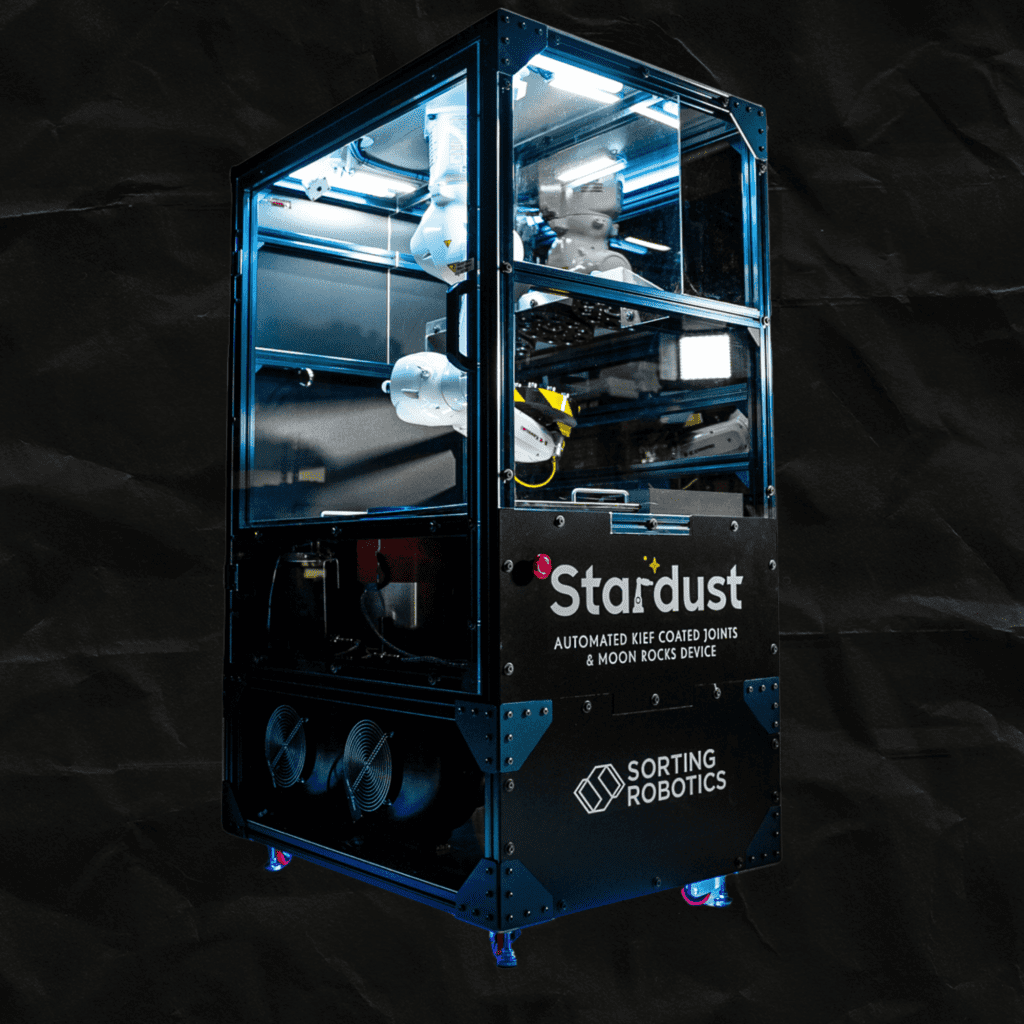
Their machines reflect that gap. Kief coating, infusion, and hash hole production have always been high-touch processes with a narrow margin for error. Anyone who has tried to hand-roll a hash hole, evenly coat a joint in kief, or infuse a batch of pre-rolls at scale knows the struggle. The Stardust unit automates kief-coated pre-rolls, a product type in high demand. Stardust allows operators to tune coating profiles, apply powdered concentrates like kief or diamonds, and maintain coverage consistency. The machine can process up to 1,500 pre-rolls an hour, which reframes a once-specialty SKU as something that can be produced reliably at scale.
Pre-roll infusion tells a similar story. Jiko, introduced in 2020, was the first automated infusion system on the market and helped define the modern infused joint category. Producing roughly 1,000 infused joints an hour, the appeal is not just speed but accuracy. Hand infusion is time-consuming and imprecise. With Jiko and its successor, Jiko+, operators can handle everything from distillate to rosin and sticky concentrates. Jiko+ in particular addresses the challenges of hash holes, another premium pre-roll. Sorting Robotics automation brings predictability to some of the most variable parts of the production chain and helps operators protect margins while building their brands.
RollPros Really Rolls
RollPros takes a different approach; the most common way pre-rolls are made is by stuffing cones. This means no need to close the joint paper or seal the roll, but introduces potential issues with uneven airflow and density, leading to tunneling and the dreaded canoeing, where one section of the roll burns faster than the rest. Their Blackbird system solves this problem by actually rolling the joints with an automated process similar to how you would hand-roll. This addresses the main reason why some consumers avoid pre-rolls altogether. Draw consistency matters, and the Blackbird gives operators a measurable way to dial in airflow.

Rolling at scale opens a new lane for brands that want to deliver a premium experience without relying on teams of hand rollers. The Blackbird holds up to 1.5 pounds of flower at a time and can be continuously refilled. Using strain-specific recipes that match grind type, moisture content, and airflow, it pumps out perfect per-rolls. Even the most skilled hand rollers can’t compete with the speed that scale requires. Rolling hundreds or thousands of joints by hand is slow, physically demanding, and borderline crazy; doing it with uniformity is even harder. By automating the rolling process rather than the cone-stuffing approach, RollPros gives producers a way to maintain the burn qualities consumers associate with a hand-rolled joint. They also have the Blackbird XXL, which is a scaled-up version ready to roll blunts with speed and precision.
In the broader automation conversation, RollPros has introduced a level of repeatability and quality that humans can’t achieve in hand-rolled joints, which means less labor tied up in a tricky manual task and more confidence that the pre-rolls leaving their facility will burn the way consumers expect.
Automation Awareness
One of the biggest questions that comes up around automation, outside of impact on the trichomes, is impact on the jobs, which is fair because the industry has always leaned on that human touch. Automation does, without a doubt, reduce roles, but those are the repetitive roles that can have high churn and low satisfaction. Eight-hour trim shifts, hand infusing pre-rolls, or hand rolling at scale all day are not sustainable tasks. From what I’ve seen, adding automation can mean the team is reduced slightly, but more commonly, the team is reallocated. Employees are able to move to other departments like cultivation, compliance, or packaging, learn new skills, be happier, and advance their careers instead of getting bogged down in repetition.
That doesn’t mean automation is magic to solve all your worries. Machines come with learning curves, installation, maintenance, and cleaning. Getting configurations and settings dialed in and training can take time. What can happen is the machine itself becomes the bottleneck it was meant to solve, which is why training matters and operator skill is just as important. Automation is a tool, not a shortcut. It can significantly improve a process, but it can also expose weaknesses in a process if it isn’t ready for the speed/complexity.
There’s also the cost of automation to address. These systems aren’t cheap; even after purchase, there are consumables, cleaning, and ongoing operational costs to consider. As margins tighten and competition steadily increases, the gap between manual labor and automated throughput will continue to widen, showing clearer ROI. Automation shifts where and how the work happens rather than replacing it. Like everything else in cannabis, it is a balance but one worth entertaining.
What’s Next for Automation in Cannabis?
It is clear that cannabis will continue to scale to mirror traditional manufacturing sectors. National brands will need national consistency, which means processes will tighten. GMP-style workflows and automation will become key for those who haven’t implemented them yet. Over time, we’ll see automation continuing to spring up across the seed-to-sale pipeline. There’s already too many companies to name automating cultivation, watering, marketing, drying, curing, reporting, and everything else it takes to keep the operations afloat.
Mobius, Sorting Robotics, and RollPros each represent a different piece of that future. Pairing industrial scale with precision robotics and craft-quality finishing touches. The bigger picture is that cannabis is not losing its craft identity as automation grows; it is gaining the infrastructure it needs to survive long term. Brands that scale successfully will be the ones that can maintain quality while still meeting demand, and that is where these tools make the difference. Automation ideally doesn’t erase the human element. If anything, it highlights where humans are most valuable.
Operators will be spending less time on repetitive strain tasks and more time on quality control, product development, and the work that actually differentiates one brand from another. The question isn’t whether automation belongs in cannabis. It’s already here, and the results speak for themselves. The real question for operators is where automation fits into their process and how it can remove the bottlenecks holding them back. Companies like Mobius, Sorting Robotics, and RollPros aren’t just equipment manufacturers. They are early markers of where the industry is heading.